


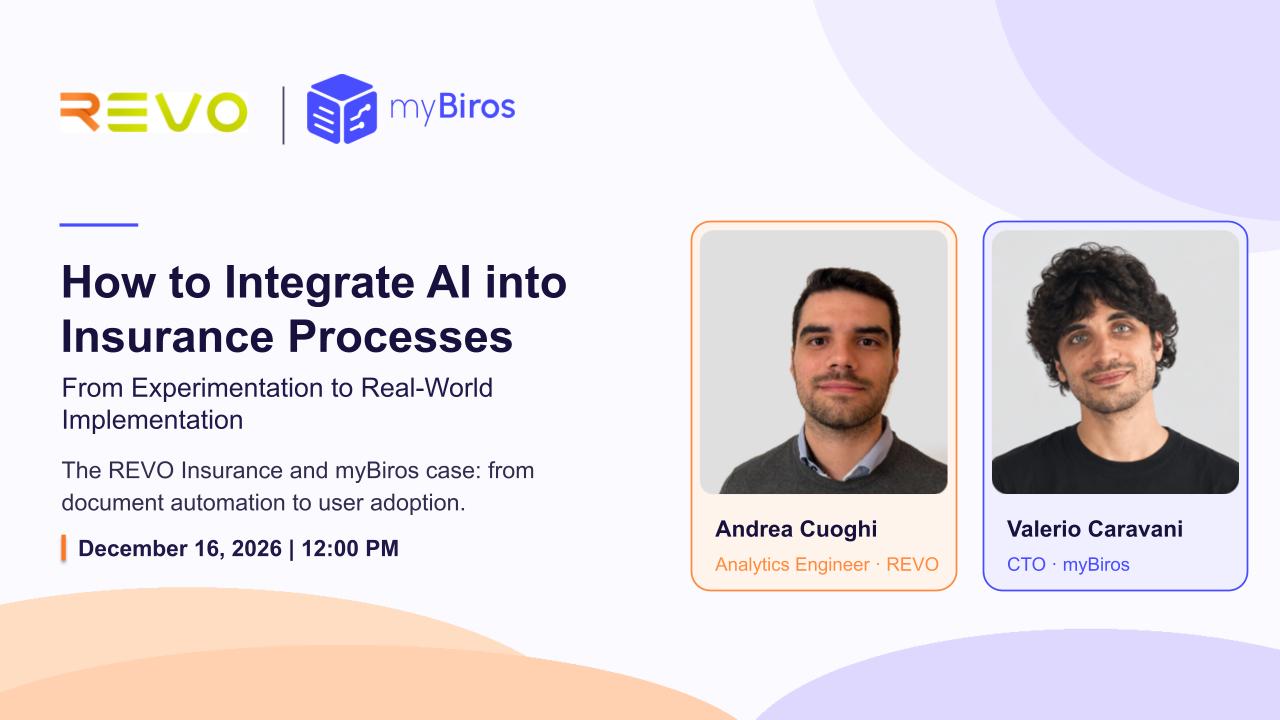
How to integrate AI into insurance processes
REVO Insurance and myBiros share how AI can be integrated into insurance processes through a real-world use case involving automated income document processing for credit limit assessments in surety insurance.
Online Webinar | December 16, 2026 | 12:00 PM (CET)
How can an operational need be transformed into an artificial intelligence solution that is fully integrated into insurance processes?
In this webinar, REVO Insurance and myBiros will share their experience developing a solution to support the processing of income documents as part of the credit limit assessment process for surety insurance policies.
The session will explore the journey from AI experimentation to real-world implementation, covering solution design, integration, usability, data quality control, and value measurement.
What We'll Cover
Drawing on their joint experience, REVO Insurance and myBiros will explore the key stages of integrating AI into business processes:
- From Business Need to Solution: How to identify a process to improve and define clear project objectives.
- Integration into Existing Workflows: How to incorporate intelligent document processing into day-to-day business operations.
- Usability and Data Quality Control: The role of users in validating information and successfully adopting new technology.
- Measuring Business Value: How to assess results and the operational impact of an AI-powered solution.
Meet the Speakers
Valerio Caravani
CTO | myBiros
Andrea Cuoghi
Analytics Engineer | REVO Insurance
The two speakers will share their technological and operational perspectives, discussing key decisions, challenges, and lessons learned throughout the project.
Who Should Attend?
This webinar is designed for insurance professionals, IT and Innovation leaders, Operations teams, and anyone involved in digital transformation and business process automation.
An opportunity to explore a real-world AI use case and gain practical insights into implementing artificial intelligence within your organization.
How to Join
Attendance is free, with registration required via LinkedIn.
Date: Wednesday, December 16, 2026
Time: 12:00 PM (CET)
Platform: Google Meet
To attend, please register through the dedicated LinkedIn event: REGISTER FOR THE WEBINAR ON LINKEDIN.
Registered participants will receive an email with instructions on how to join the webinar via Google Meet.
Articles in the same category
How to integrate AI into insurance processes
REVO Insurance and myBiros share how AI can be integrated into insurance processes through a real-world use case involving automated income document processing for credit limit assessments in surety insurance.
Read it now
Digital sale of RCA insurance policies: how IDP improves quotes and onboarding
IDP makes it possible to automatically extract data from RCA insurance policies and use it to generate personalized quotes, reducing manual form filling and abandonment in the digital funnel.
Read it now
Document AI: when general-purpose model APIs are not enough
General-purpose model APIs work well for prototypes, but at scale, document data extraction requires validations, integrations, and exception handling. The model is only one part of the system.
Read it now
AI for Gas and Electricity Switching: Less Friction, More Contracts
Extracting data from utility bills and documents still slows down many switching processes. With myBiros’ specialized AI, utilities and sales networks can automate data entry, reduce errors and accelerate contract signing.
Read it now
Accelerating Time-to-Yes in Lending with AI
AI accelerates the analysis of financial documents, reduces manual work, and transforms data into structured information, enabling banks and financial intermediaries to respond faster and improve their Time-to-Yes.
Read it now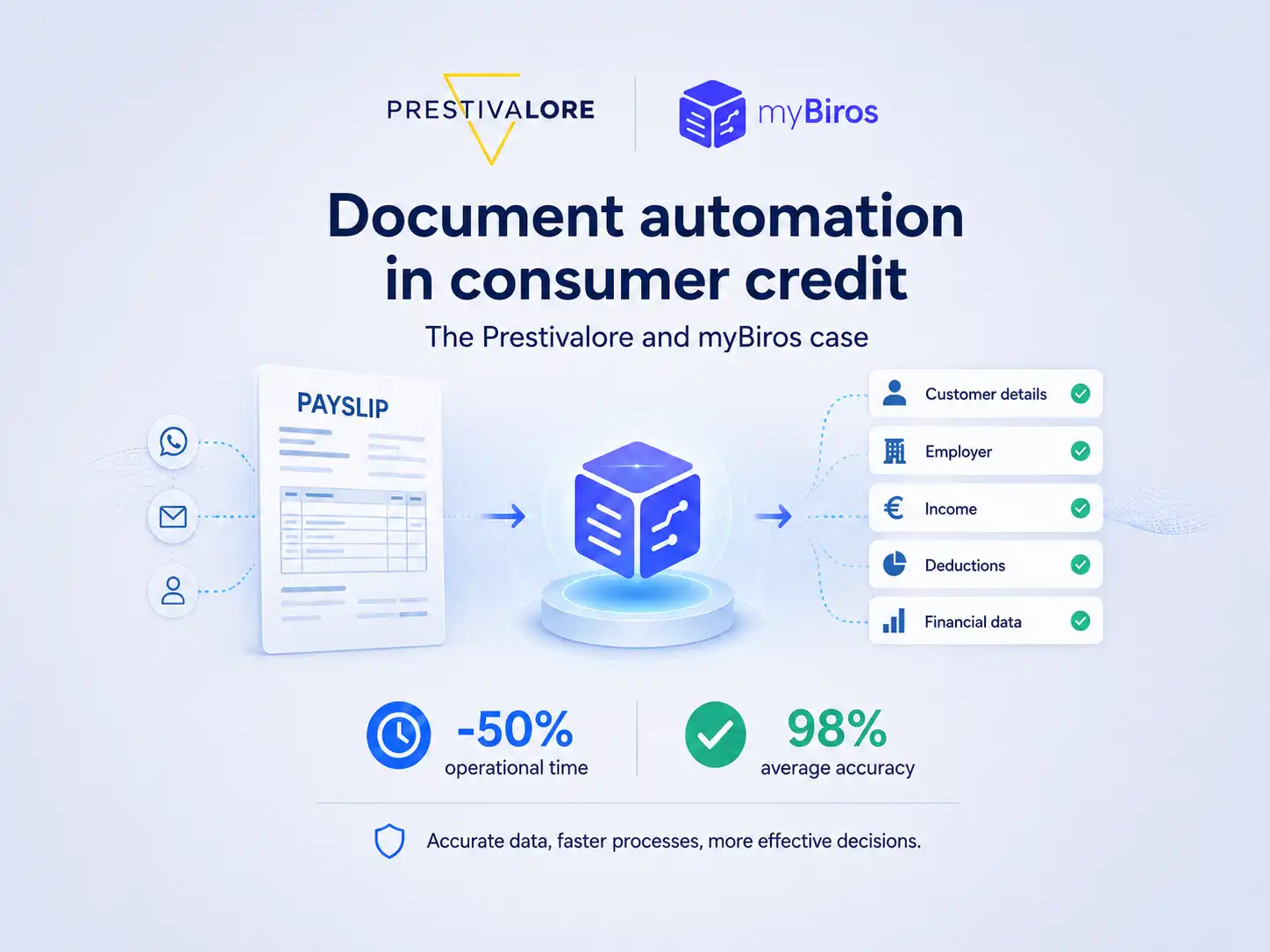
How Prestivalore reduced operational times by 50% with myBiros
Prestivalore processes approximately 90,000 documents each year, including payslips and identity documents. Thanks to myBiros, the company has automated data extraction, reduced manual work, and achieved an average accuracy rate of 98%.
Read it now


