



Accelerating Time-to-Yes in Lending with AI
AI accelerates the analysis of financial documents, reduces manual work, and transforms data into structured information, enabling banks and financial intermediaries to respond faster and improve their Time-to-Yes.

In the financial sector, the speed at which a financing application is assessed and approved has become a critical competitive factor.
Customers and financial intermediaries expect fast responses, straightforward procedures, and a consistent experience across both digital and branch channels.
However, personal loans, salary- or pension-backed loans under Italy’s Cessione del Quinto scheme, and mortgages still require the collection and analysis of a large number of documents, including payslips, identity documents, bank statements, pension statements, contracts, and notarial deeds.
When this information must be entered, checked, and cross-referenced manually, the process slows down. The risk of errors, operating costs, and the likelihood that customers will abandon their applications before completing them also increase.
Intelligent Document Processing helps overcome these limitations by transforming complex documents into structured data that credit assessment systems can use immediately.
What Is Time-to-Yes?
Time-to-Yes is the amount of time required to provide a customer with a positive response or a reliable preliminary assessment of their eligibility for financing.
It does not necessarily correspond to the final disbursement of the loan. Instead, it represents the point at which the financial institution has gathered enough information to:
- verify that the application is complete;
- perform preliminary document checks;
- assess the affordability of the financing request;
- identify potential anomalies;
- proceed with the underwriting or approval stage.
Reducing Time-to-Yes therefore means improving the entire process through which documentation is collected and assessed.
A faster response increases the likelihood that customers will complete their applications, reduces operators’ workloads, and enables financial institutions to process a higher number of requests.
The Limitations of Traditional Lending Processes
Financing processes are generally managed through two main channels: digital and physical.
Each channel presents different challenges, but both share the same underlying issue: document management still relies heavily on manual work.
Challenges in the Digital Channel
Within a digital funnel, customers are generally required to complete forms, enter personal and income information, and upload one or more documents.
Even when the entire process takes place through a website or mobile application, the customer experience is not necessarily automated.
Customers may still be required to:
- manually copy information from a payslip;
- enter details that are already available on their identity document;
- search for specific values within a Certificazione Unica;
- upload a document again because the original file is unreadable;
- wait for an operator to review the application;
- be contacted to correct missing or inaccurate information.
Every additional step increases the risk of abandonment.
Manual data entry is particularly problematic on smartphones, where long forms and complex document requirements can cause frustration. A simple typing error may also trigger an additional review, slowing the process down even further.
Inefficiencies in the Physical Channel
In channels involving agents, brokers, branches, and back-office teams, documents are often collected during a meeting and then submitted to a central system.
The operator must open each file, identify the relevant information, and manually enter it into the CRM or application management platform.
This approach results in:
- long processing times;
- duplicated activities;
- transcription errors;
- data entered in inconsistent formats;
- difficulty verifying whether an application is complete;
- delays in transferring applications between the sales network and the back office.
The time spent copying information from a payslip or bank statement does not generate direct value. Instead, it diverts resources away from sales, advisory services, and customer relationship activities.
How Intelligent Document Processing Transforms Lending Processes
Intelligent Document Processing, or IDP, automates document understanding through artificial intelligence, OCR, and vision-language models.
Unlike a traditional OCR system, which mainly recognises the characters contained in an image, an IDP platform is designed to interpret both the structure and the meaning of the information.
For example, the system can recognise that a particular value represents:
- net salary;
- gross income;
- employer;
- employment start date;
- tax identification number;
- identity document number;
- instalment amount;
- bank account balance.
The extracted information is returned in a structured format and can be transferred directly to the CRM, application management system, or credit decisioning engine.
The myBiros IDP Platform for the Lending Industry
myBiros has developed an Intelligent Document Processing platform based on an sVLM model specifically designed for document processing.
The model is trained to recognise not only text, but also the position of different elements, the relationships between fields, and the distinctive characteristics of documents used in financial processes.
The platform can process documents such as:
- payslips;
- Certificazioni Uniche;
- pension statements;
- identity documents;
- bank statements;
- contracts;
- income documentation;
- notarial deeds;
- documents relating to loans and mortgages.
The objective is not simply to digitise a document, but to transform it into a set of reliable, verifiable data that is ready to be used in the subsequent stages of the lending process.
How the Automated Process Works
The workflow can be integrated into both digital channels and physical distribution networks.
1. Document Upload
The customer or operator uploads a photograph, scan, or PDF file.
The document can be uploaded through:
- a website;
- a mobile application;
- a customer portal;
- an agent portal;
- a CRM;
- a company management system.
2. Classification
The system automatically identifies the type of document received.
For example, it can distinguish a payslip from a Certificazione Unica, an identity document from a bank statement, or a pension statement from another type of administrative document.
3. Data Extraction
The model identifies the relevant fields and associates them with their correct meaning.
From a payslip, for example, it may extract the employee’s name, employer, reference period, net salary, deductions, and any other information required by the process.
4. Normalisation
The data is converted into consistent formats.
Dates, amounts, tax identification numbers, and other information may appear in different formats. Normalisation standardises these values before they are transferred to the company’s systems.
5. Validation
The platform can verify that all mandatory fields are present and flag missing, inconsistent, or potentially incorrect values.
Customers can therefore correct the document or complete the application immediately, without having to wait for a subsequent manual review.
6. Integration
Structured data is transferred to the CRM, application management system, or credit decisioning platform through APIs.
This eliminates manual re-entry and accelerates the transition from document collection to underwriting and assessment.
A Simpler Digital Lending Experience
In the digital channel, IDP can turn document upload into a self-service experience.
Customers take a photograph or upload their payslip, Certificazione Unica, and identity document. The platform automatically extracts the information and pre-populates the application fields.
Customers only need to review and confirm the data.
This approach reduces:
- the amount of information customers need to enter manually;
- data-entry errors;
- requests for additional documentation;
- waiting times;
- application abandonment.
Real-time validation also makes it possible to immediately flag a blurred image, an incomplete document, or an unrecognised field.
As a result, the application can reach the central system already complete and structured.
Greater Productivity for Agents and Back-Office Teams
In the physical channel, the platform allows agents and operators to upload photographs, PDFs, or scans of documents collected during meetings with customers.
The extracted data can be transferred directly to the corresponding application in the CRM.
Agents no longer need to manually transcribe every value and can immediately verify whether the documentation is complete.
The back office receives a more organised application, with information that is already structured and available for subsequent checks.
Automation therefore helps organisations:
- reduce repetitive activities;
- increase the number of applications that can be processed;
- limit errors;
- improve collaboration between the sales network and head office;
- shorten underwriting times.
AI for Personal Loans, Salary- or Pension-Backed Loans, and Mortgages
Document types and verification requirements vary according to the financial product. For this reason, a Document AI system must be able to adapt to different processes.
Personal Loans
Speed is critical in personal lending.
Customers expect a rapid response and can easily compare multiple offers. A slow procedure or repeated requests for documents may lead them to choose another financial provider.
AI can automate the collection of personal and income data, pre-populate the application, and immediately flag missing information.
The result is a more streamlined funnel and a faster preliminary assessment.
Salary- or Pension-Backed Loans
Salary- or pension-backed loans under Italy’s Cessione del Quinto scheme require the analysis of highly specific documents, including payslips, pension statements, and Certificazioni Uniche.
Document quality may vary, and the required information may appear in different positions depending on the employer or public authority that issued the document.
A specialised IDP system can identify relevant fields even when the layout changes, normalise the values, and transfer them to the application.
This reduces rework and accelerates the verification of income documentation.
Mortgages
Mortgages are among the most complex lending processes because of the number, variety, and origin of the required documents.
An application may include personal, income, banking, land registry, and notarial documentation. Information must be verified and cross-referenced across multiple sources.
Intelligent Document Processing can support automatic classification, data extraction, and the identification of potential inconsistencies.
AI does not replace specialist assessment, but it reduces the time spent searching for and transcribing information.
The Measurable Benefits of AI in Lending
Document automation generates benefits for both internal efficiency and customer experience.
Results observed in the processes supported by myBiros include:
- up to a 50% reduction in traditional processing times;
- the elimination of up to 90% of repetitive activities;
- data-extraction accuracy of up to 97%.
Actual performance naturally depends on the document type, file quality, required fields, and process configuration.
The main advantage is not simply the ability to extract information more quickly. It is the ability to make structured data available at the exact moment it is needed within the application process.
Faster Time-to-Yes
A complete application can be assessed more quickly.
By reducing the time required to collect, verify, and enter data, financial institutions can provide an initial response sooner.
Higher Conversion Rates
A simpler process reduces friction.
Customers are required to complete fewer forms, receive immediate instructions, and need to resubmit documents less frequently. This can help reduce abandonment throughout the funnel.
Operational Efficiency
Data-entry activities are handled by the platform, allowing operators to focus on exceptions, controls, and customer relationships.
Automation therefore becomes a tool for increasing the value of human work, not simply for reducing processing times.
Data Quality and Reliability
Manual data entry can lead to typing errors, transposed digits, and inconsistent formats.
Automated extraction, combined with validation rules, helps maintain greater consistency between the original document and the data recorded in the system.
Traceability and Compliance
Each data point can be linked to the document and to the specific location from which it was extracted.
This traceability facilitates audits, exception management, and the verification of information used throughout the lending process.
Why a Specialised Model Is Essential
Financial documents are too complex to be handled reliably by a generic system.
The same information may appear under different labels, in different positions, or within complex tables. Documents may also contain abbreviations, codes, notes, repeated sections, and similar values with different meanings.
A model specialised in lending is configured to understand:
- document structures;
- the meaning of individual fields;
- relationships between information;
- differences between document templates;
- the data actually required by the application process.
Specialisation reduces ambiguity and makes it possible to build an extraction workflow that is more closely aligned with the organisation’s operational requirements.
Integrating IDP into Existing Systems
Adopting Intelligent Document Processing does not necessarily require replacing the organisation’s entire technology infrastructure.
The platform can be integrated with existing systems through APIs and customised workflows.
Integration may involve:
- CRMs;
- agent portals;
- mobile applications;
- customer portals;
- application management systems;
- scoring engines;
- credit decisioning systems;
- document verification workflows.
The objective is to embed automation into the existing process, ensuring that extracted data reaches the exact system and stage in which it is required.
From Document Reading to Decision-Making
AI applied to lending should not be viewed simply as a more advanced form of OCR.
Its true value comes from the ability to connect three stages:
- understanding the document;
- transforming information into structured data;
- using that data immediately within the business process.
When these stages are integrated, the document is no longer an operational obstacle. It becomes a data source that is ready to support the application.
The result is a faster, more controllable, and more scalable process.
Conclusion
Personal loans, salary- or pension-backed loans, and mortgages will continue to require extensive documentation and accurate verification.
Competitive differentiation will increasingly depend on how these documents are collected, interpreted, and integrated into financial systems.
With a specialised Intelligent Document Processing platform, banks, financial intermediaries, and lending companies can reduce manual data entry, improve information quality, and accelerate Time-to-Yes.
myBiros transforms payslips, Certificazioni Uniche, identity documents, bank statements, and complex deeds into structured data that is ready to support lending processes.
Would you like to discover how to automate your document workflow?
Contact myBiros or book a demo to identify which documents, integrations, and process stages can be optimised with AI.
Articles in the same category
Digital sale of RCA insurance policies: how IDP improves quotes and onboarding
IDP makes it possible to automatically extract data from RCA insurance policies and use it to generate personalized quotes, reducing manual form filling and abandonment in the digital funnel.
Read it now
Document AI: when general-purpose model APIs are not enough
General-purpose model APIs work well for prototypes, but at scale, document data extraction requires validations, integrations, and exception handling. The model is only one part of the system.
Read it now
AI for Gas and Electricity Switching: Less Friction, More Contracts
Extracting data from utility bills and documents still slows down many switching processes. With myBiros’ specialized AI, utilities and sales networks can automate data entry, reduce errors and accelerate contract signing.
Read it nowAccelerating Time-to-Yes in Lending with AI
AI accelerates the analysis of financial documents, reduces manual work, and transforms data into structured information, enabling banks and financial intermediaries to respond faster and improve their Time-to-Yes.
Read it now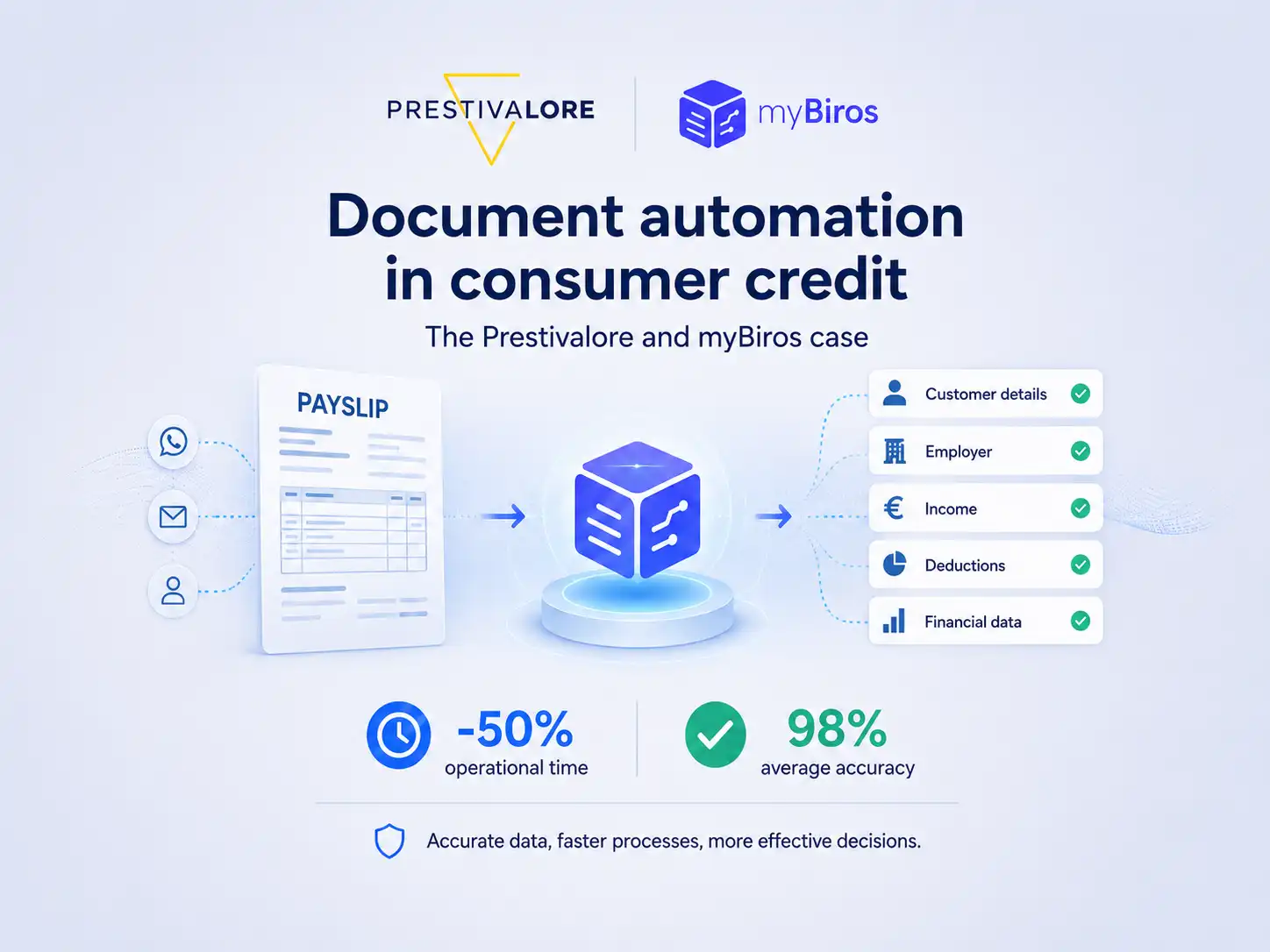
How Prestivalore reduced operational times by 50% with myBiros
Prestivalore processes approximately 90,000 documents each year, including payslips and identity documents. Thanks to myBiros, the company has automated data extraction, reduced manual work, and achieved an average accuracy rate of 98%.
Read it now
Beyond the Demo: The Hidden Complexities of Training and Validating VLMs for Document AI
Training a VLM for Document AI may look straightforward in a demo, but bringing it into production requires a robust pipeline: multimodal datasets, controlled fine-tuning, and reliable output validation.
Read it now


.svg)
.svg)
