



Digital sale of RCA insurance policies: how IDP improves quotes and onboarding
IDP makes it possible to automatically extract data from RCA insurance policies and use it to generate personalized quotes, reducing manual form filling and abandonment in the digital funnel.

The digital sale of RCA insurance policies requires fast, accurate and simple processes for the user. Every additional step, recognition error or prolonged wait can increase the abandonment rate and reduce the ability of the online channel to generate new contracts.
One of the most delicate moments in the funnel concerns the collection of the information needed to formulate a personalized quote. The customer normally has to provide personal data, vehicle information, bonus-malus class, current coverage and other elements contained in the insurance documentation.
Asking the user to manually enter all this information means making the process longer and more complex. One possible alternative is to allow them to upload their insurance contract, a previous policy or another useful document and let an Intelligent Document Processing system automatically extract the data.
For insurance companies, however, the question is not only how to automate this step, but also which technology to use. Is it better to develop the system internally or integrate a specialized IDP platform?
The digitalization of the RCA sales funnel
In the insurance sector, the digital experience has become a central component of the sales process.
A potential customer requesting an online quote expects to be able to complete the process quickly, without having to manually search for information within contracts, claims history certificates and vehicle documents.
A possible digital funnel for the sale of an RCA insurance policy may include:
- uploading the previous insurance policy;
- automatic identification of the document type;
- extraction of the relevant data;
- verification of the information;
- generation of the quote;
- selection of coverage;
- signing of the contract;
- completion of onboarding.
In this process, document extraction is a particularly important step. If the data is acquired correctly, the quote can be generated almost instantly. If the system is unable to interpret it, the customer is forced to enter it manually or wait for verification by an operator.
Document automation must therefore not be limited to reading the text contained in the file. It must transform heterogeneous documents into structured, reliable data that can be immediately used by insurance systems.
Which data to extract from an RCA policy
Insurance documents contain a large amount of information that can be used during the quoting and onboarding phase.
Potentially relevant data includes:
- policyholder's first and last name;
- tax code;
- residential address;
- policy number;
- insurance company;
- start and expiry date;
- vehicle license plate;
- make and model;
- universal bonus-malus class;
- pricing formula;
- coverage limits;
- additional coverage;
- deductibles and excesses;
- information relating to insurance history;
- any claims data;
- information about the owner and usual driver.
The problem is that this data is not always located in the same position.
Each company uses different models, layouts, terminology and structures. Even documents containing equivalent information may feature completely different tables, sections and labels.
This variability is compounded by the quality of the uploaded file. The system may receive a perfectly readable digital PDF, a scan, a photo taken with a smartphone, a tilted document or an image with shadows, reflections and poorly visible areas.
Why simple OCR is not enough
A traditional OCR system can recognize the characters contained in the document, but this does not mean that it is able to understand which information is actually relevant.
For example, an insurance policy may contain multiple dates, multiple amounts and several names. The system must distinguish the expiry date from the issue date, the policyholder from the insured party and the annual premium from any additional costs.
The digital sale of RCA insurance policies therefore requires a technology capable of combining:
- optical character recognition;
- layout understanding;
- document classification;
- semantic interpretation;
- data normalization;
- validation checks;
- exception management.
This is where Intelligent Document Processing comes into play.
An IDP platform does not simply return recognized text, but produces structured output that can be used directly by the quotation engine, CRM or policy management systems.
Make or Buy in insurance document automation
An insurance company that wants to automate data extraction can choose between two main approaches:
- develop a solution internally;
- integrate an existing IDP platform.
The Make model may seem advantageous when the goal is to maintain full control over the architecture, models and data. However, building a reliable system for the digital sale of RCA insurance policies requires much more than an OCR model connected to an upload interface.
It is necessary to collect and annotate insurance documents from different companies, train the models, manage new formats, monitor performance and set up an infrastructure capable of handling variable workloads.
The system must also maintain high performance under real-world conditions, when documents are incomplete, blurred or different from those used during development.
The Buy approach, on the other hand, makes it possible to use technology already designed to address these problems, reducing the time needed to bring the process into production.
The risks of an insufficiently mature internal solution
In the insurance funnel, a technical error is not only an operational problem. It can directly turn into a commercial loss.
If the system does not recognize the data correctly, the user may be forced to:
- correct numerous fields;
- repeat the upload;
- manually search for the information;
- wait for an operator to intervene;
- abandon the quote request.
Every manual step increases friction and can affect drop-off.
An internal product that is still maturing may also struggle to handle traffic peaks. Quote requests do not necessarily arrive evenly: advertising campaigns, seasonal renewals and commercial initiatives can generate sudden increases in volume.
If processing time increases excessively, the experience is no longer instantaneous. The user sees a waiting screen, does not receive the quote immediately and may choose another company.
System speed therefore becomes an integral part of the purchasing experience.
The advantages of a specialized IDP platform
Integrating a specialized IDP platform makes it possible to add an already optimized document extraction process to the funnel.
The company can focus on building the insurance offering and user experience, without having to internally develop all the components needed to classify, interpret and validate documents.
The main advantages include:
Real-time data extraction
Information can be extracted immediately after the document is uploaded and automatically transferred to the quotation engine.
Greater accuracy
A specialized system is designed to recognize heterogeneous documents and correctly interpret fields that may change position, format or label.
Reduced manual input
The customer only needs to verify the extracted information instead of filling in the entire form.
Infrastructure scalability
The platform can handle increases in volume without requiring the company to size and maintain the entire document infrastructure internally.
Reduced time to market
API integration makes it possible to introduce automation into the funnel more quickly than fully developing a proprietary solution.
Centralized performance management
Monitoring, model updates and processing time optimization can be managed by the IDP platform.
From document upload to an instant quote
An automated process can begin when the prospect uploads a photo or PDF of the previous policy.
The document is analyzed by the IDP platform, which identifies the type, recognizes the information and returns the data in a structured format, such as JSON.
The insurance application can then:
- pre-fill the form fields;
- show the data to the customer for verification;
- apply consistency checks;
- send the information to the pricing engine;
- generate the personalized quote;
- guide the customer toward signing.
The user does not need to know the exact location of the bonus-malus class or interpret the terms of the old policy. The document becomes the starting point for a guided and automated experience.
Human in the loop and exception management
Even the most advanced system must include exception management.
The platform can associate a confidence level with each data point. When the value exceeds a certain threshold, the information is used automatically. When confidence is lower, the system can ask the customer to confirm the field or send the document to an operator.
This approach makes it possible to use automation without giving up control.
The goal is not to completely eliminate human verification, but to focus it exclusively on cases that genuinely need it. Most documents can follow an automated path, while exceptions are handled separately.
How IDP can improve the conversion rate
In the digital sales process, improving conversion does not depend only on the price of the policy.
The number of fields, response speed, ease of upload and the system's ability to automatically retrieve information also influence user behavior.
An effective document experience can help to:
- reduce the time needed to obtain a quote;
- decrease the number of fields to be completed;
- limit input errors;
- increase the number of completed quotes;
- reduce abandonment during onboarding;
- improve the smartphone experience;
- reduce manual back-office checks.
IDP therefore becomes a conversion rate optimization tool, as well as an operational automation technology.
Which metrics to monitor
To evaluate the effectiveness of the solution, it is necessary to analyze both technical performance and commercial results.
The main metrics may include:
- accuracy of extracted fields;
- percentage of documents processed automatically;
- average processing time;
- percentage of fields manually corrected;
- number of documents sent to the back office;
- quote completion rate;
- drop-off after upload;
- average time required to obtain the offer;
- conversion from quote to contract;
- average handling cost per case.
These indicators make it possible to understand whether automation is actually improving the funnel or simply shifting work from one stage to another.
Make or Buy: which approach should you choose?
The choice depends on the available skills, volumes, project timelines and the level of specialization required.
Internal development can be considered when the company has a team dedicated to Document AI, a representative dataset, adequate infrastructure and the ability to maintain the models over time.
Integrating an IDP platform, on the other hand, is particularly advantageous when the goal is to:
- reduce time to market;
- automate the funnel quickly;
- manage documents from different sources;
- obtain predictable response times;
- scale without building new infrastructure;
- focus resources on the insurance product.
In many cases, the most effective solution may be hybrid: the company keeps pricing logic, business rules and user experience in-house, while entrusting document interpretation to a specialized platform.
Learn more about the topic: Make or Buy: how to choose the right document automation solution
myBiros for extracting data from insurance policies
myBiros makes it possible to transform policies, contracts and insurance documents into structured data ready to be integrated into digital processes.
Through APIs, the platform can be connected to the quotation funnel to classify documents, extract the required information and return output that can be used by company systems.
This allows insurance companies, intermediaries and insurtechs to build faster and more scalable processes, reducing manual input and improving the customer experience.
In a market where quote speed can determine the user's choice, document automation is not only a technical improvement. It becomes a strategic component of digital sales.
Conclusions
The online sale of RCA insurance policies provides a concrete example of the impact of the Make or Buy dilemma in Intelligent Document Processing.
Internally developing a system capable of reading different insurance documents, maintaining high accuracy and responding in real time requires skills, data, infrastructure and continuous maintenance.
A specialized IDP platform, on the other hand, makes it possible to integrate more quickly an extraction process already designed to manage complex documents and variable volumes.
The result is a simpler funnel: the customer uploads their policy, verifies the extracted data and receives a personalized quote without having to manually fill in dozens of fields.
Reducing friction means increasing the likelihood that the prospect will complete the journey. For this reason, in digital insurance, the quality of document extraction can have a direct impact on conversion rates.
Articles in the same category
Digital sale of RCA insurance policies: how IDP improves quotes and onboarding
IDP makes it possible to automatically extract data from RCA insurance policies and use it to generate personalized quotes, reducing manual form filling and abandonment in the digital funnel.
Read it now
Document AI: when general-purpose model APIs are not enough
General-purpose model APIs work well for prototypes, but at scale, document data extraction requires validations, integrations, and exception handling. The model is only one part of the system.
Read it now
AI for Gas and Electricity Switching: Less Friction, More Contracts
Extracting data from utility bills and documents still slows down many switching processes. With myBiros’ specialized AI, utilities and sales networks can automate data entry, reduce errors and accelerate contract signing.
Read it now
Accelerating Time-to-Yes in Lending with AI
AI accelerates the analysis of financial documents, reduces manual work, and transforms data into structured information, enabling banks and financial intermediaries to respond faster and improve their Time-to-Yes.
Read it now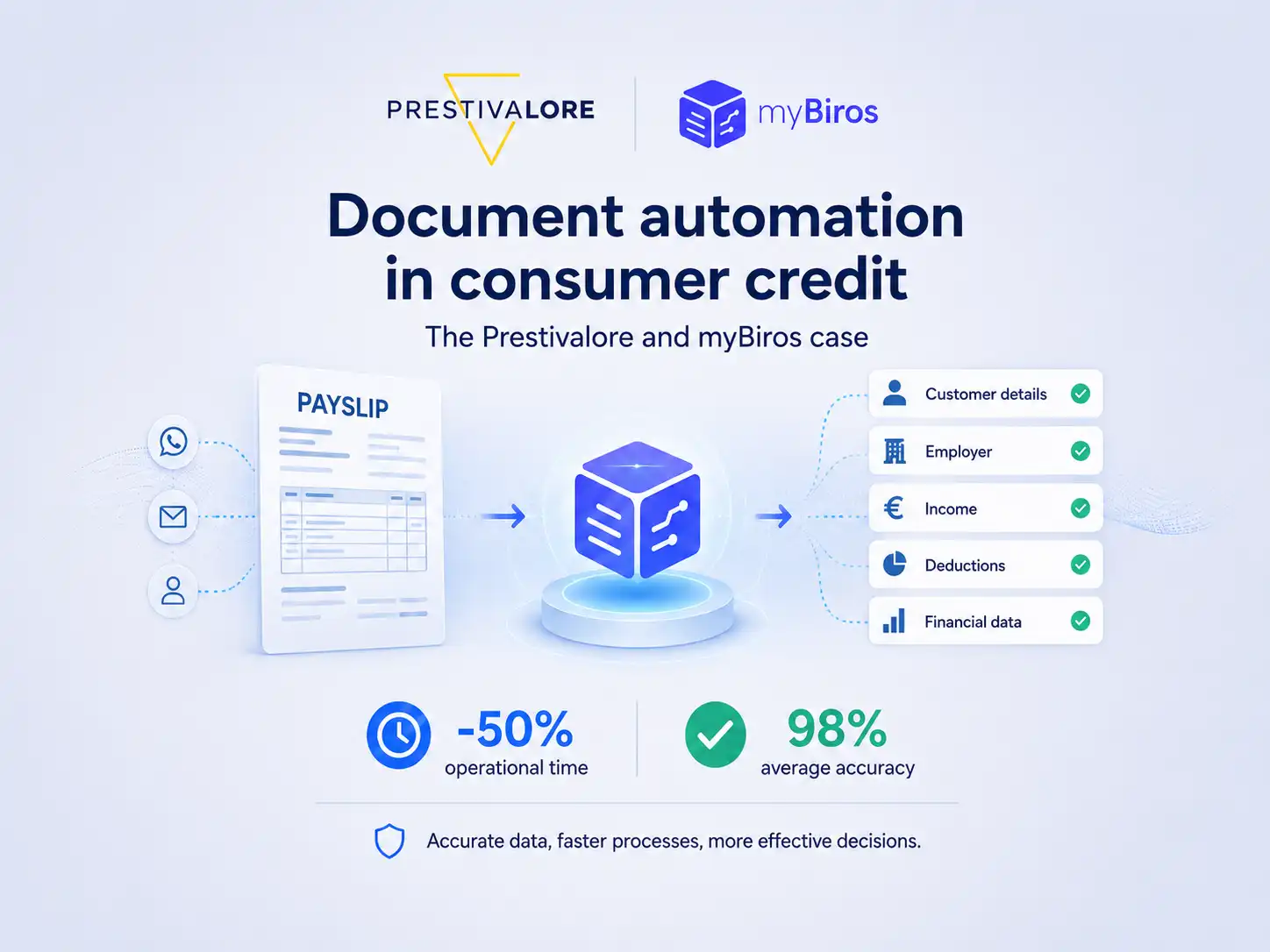
How Prestivalore reduced operational times by 50% with myBiros
Prestivalore processes approximately 90,000 documents each year, including payslips and identity documents. Thanks to myBiros, the company has automated data extraction, reduced manual work, and achieved an average accuracy rate of 98%.
Read it now
Beyond the Demo: The Hidden Complexities of Training and Validating VLMs for Document AI
Training a VLM for Document AI may look straightforward in a demo, but bringing it into production requires a robust pipeline: multimodal datasets, controlled fine-tuning, and reliable output validation.
Read it now

