

How Prestivalore reduced operational times by 50% with myBiros
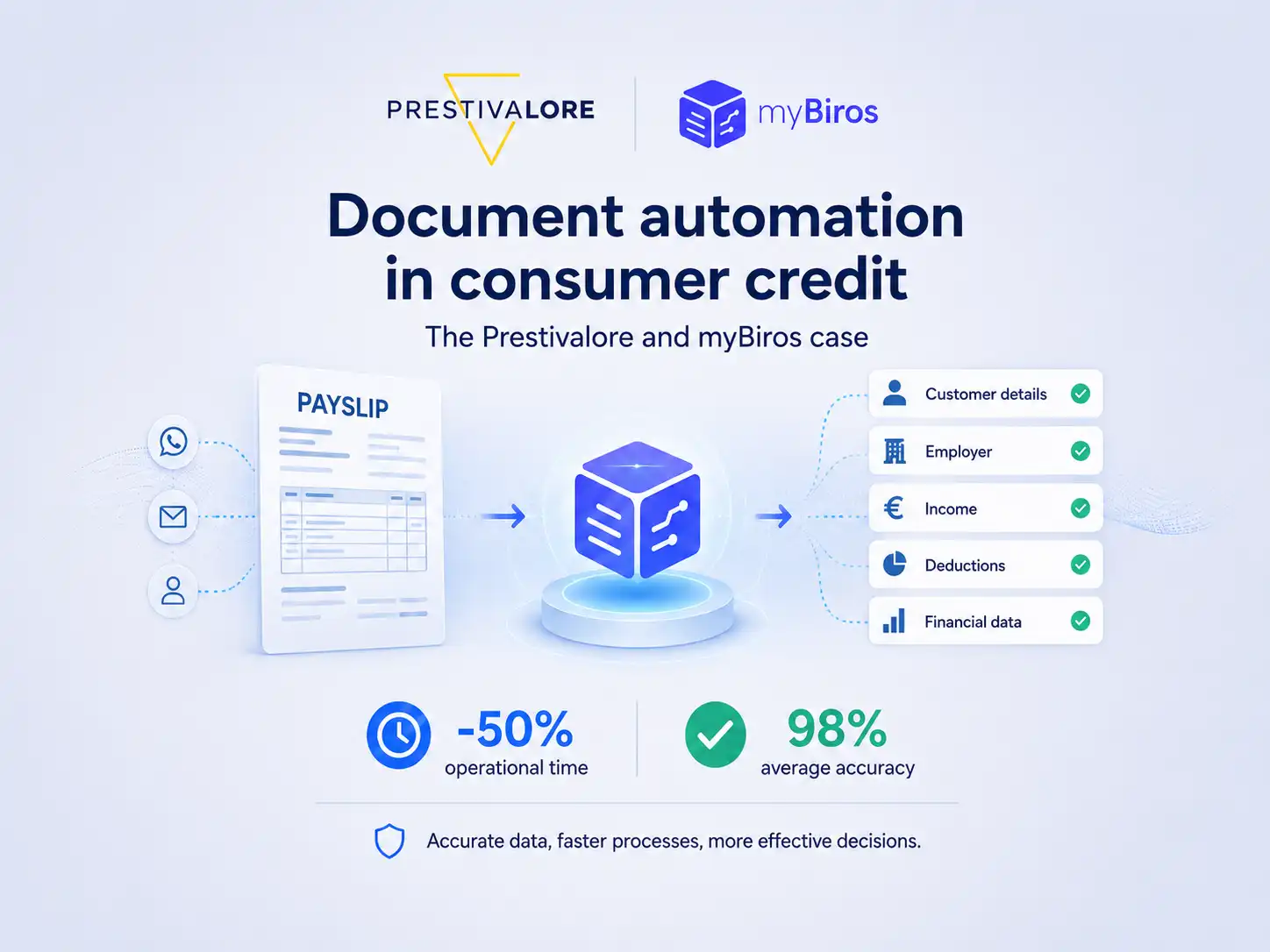
Prestivalore processes approximately 90,000 documents each year, including payslips and identity documents. Thanks to myBiros, the company has automated data extraction, reduced manual work, and achieved an average accuracy rate of 98%.

In the consumer lending sector, the speed at which documents are analysed can directly affect service quality and customer response times.
Payslips, identity documents, and personal information must be collected, verified, and accurately entered into company systems. When these activities are performed manually, however, they can take several minutes for each application and increase the risk of transcription errors.
This was the challenge faced by Prestivalore, a company specialising in consumer credit advisory services, particularly salary-backed and pension-backed loans.
By introducing myBiros, Prestivalore transformed a process based on manual data entry into an automated workflow capable of extracting and structuring document information in just a few seconds.
The challenge: managing approximately 90,000 documents every year
Every year, Prestivalore processes around 90,000 documents, mainly payslips and identity documents submitted by customers interested in receiving financial advice.
Documents arrive through different channels, primarily:
- WhatsApp;
- email;
- direct communication with operators.
Once the documentation was received, operators had to open each file, read the information it contained, and manually copy it into the company’s systems.
The information to be collected included:
- tax identification number;
- customer personal details;
- employer;
- income;
- deductions;
- financial information required to assess the application.
This process could take up to 10 minutes for each payslip. Manual transcription also exposed the company to the risk of incomplete data, typing errors, and inconsistencies between the original document and the information recorded.
With high document volumes, even a small inefficiency repeated thousands of times can become a significant operational cost.
The limitations of manual data entry in consumer lending
Manual data entry was not only time-consuming. It also required operators to spend a considerable portion of their time on repetitive, low-value tasks.
Before they could analyse a customer’s financial situation, operators had to:
- receive and open the document;
- identify the relevant information;
- copy it into the management system;
- verify the accuracy of the data;
- associate the customer with the relevant company or employer.
The financial assessment could begin only after all these steps had been completed.
In a credit approval process, moreover, an inaccurately transcribed data point can slow down the application, require additional checks, or lead to requests for further documentation.
Prestivalore therefore needed a solution capable of accelerating data collection without compromising accuracy.
The solution: automated data extraction with myBiros
To optimise the process, Prestivalore adopted myBiros, the Intelligent Document Processing platform designed to automatically read, interpret, and extract information from documents.
The solution made it possible to automate three key activities:
- extracting data from payslips;
- completing customer records;
- matching customers with their employer.
The process is straightforward: the operator uploads the payslip to the platform, and myBiros automatically identifies the relevant fields, returning the information in a structured format that is ready to be used in the company’s systems.
A task that previously took several minutes can now be completed in just a few seconds.
Operators no longer need to search for and manually copy each piece of information. Instead, they can focus on verifying the data and assessing the application.
From unstructured documents to usable data
A payslip is a complex document. Its layout, field positioning, labels, and formats may vary depending on the software used, the employer, or the type of employment contract.
A traditional OCR system can recognise the text contained in a document, but it may not always understand its meaning or convert it into immediately usable information.
myBiros uses OCR, Computer Vision, and advanced Artificial Intelligence models to recognise not only the characters, but also the role each piece of data plays within the document.
For example, the platform can distinguish net income from a deduction, identify the employee’s tax identification number, and recognise information relating to the employer.
The result is not simply a transcription of the payslip, but a set of classified and structured data ready to support business processes.
The results achieved by Prestivalore
The automation introduced with myBiros delivered two main results:
50% reduction in operational processing time
Reducing manual activities enabled operators to process documentation more quickly and dedicate greater attention to customer advisory services and application assessment.
98% average accuracy
The high level of extraction accuracy reduced the risk of transcription errors and the need to carry out repetitive checks on the data entered.
As the Prestivalore team explained:
“Previously, we had to enter data manually. Now, all we need to do is upload the document. myBiros has enabled us to take a major step forward.”
A faster and more scalable process
The benefits of document automation go beyond the time saved on each individual payslip.
An automated system makes it possible to manage growing document volumes without proportionally increasing the operators’ workload. This makes the process more scalable and helps the company maintain consistent response times, even during periods of high demand.
Standardised extraction also produces more consistent data, simplifying:
- internal checks;
- integration with CRM and management systems;
- information retrieval;
- application monitoring;
- the creation of automated workflows.
Intelligent Document Processing therefore becomes a strategic component of the entire advisory process, rather than simply a tool for reading documents.
Why automate payslip analysis?
The Prestivalore case demonstrates how automation can deliver tangible process improvements in the financial services and consumer lending sectors.
Companies that receive payslips, identity documents, certificates, and forms every day can significantly reduce the time spent on data entry, limit errors, and accelerate the start of application processing.
The main benefits include:
- faster information capture;
- fewer repetitive operations;
- greater data accuracy;
- shorter response times;
- the ability to manage growing document volumes;
- better use of operators’ expertise.
The goal is not to eliminate human oversight, but to provide operators with information that is already organised, allowing them to focus on decisions that require experience and judgement.
Automate your document processes with myBiros
With myBiros, identity documents, income documents, and other business documents can be automatically transformed into structured data and integrated into existing workflows.
The platform helps reduce manual tasks, accelerate application processing, and improve the quality of the information used across business processes.
Do you manage large volumes of documents and want to reduce the time spent on manual data entry?
Contact us or book a myBiros demo to discover how to automate your document processing workflow.
Articles in the same category
Digital sale of RCA insurance policies: how IDP improves quotes and onboarding
IDP makes it possible to automatically extract data from RCA insurance policies and use it to generate personalized quotes, reducing manual form filling and abandonment in the digital funnel.
Read it now
Document AI: when general-purpose model APIs are not enough
General-purpose model APIs work well for prototypes, but at scale, document data extraction requires validations, integrations, and exception handling. The model is only one part of the system.
Read it now
AI for Gas and Electricity Switching: Less Friction, More Contracts
Extracting data from utility bills and documents still slows down many switching processes. With myBiros’ specialized AI, utilities and sales networks can automate data entry, reduce errors and accelerate contract signing.
Read it now
Accelerating Time-to-Yes in Lending with AI
AI accelerates the analysis of financial documents, reduces manual work, and transforms data into structured information, enabling banks and financial intermediaries to respond faster and improve their Time-to-Yes.
Read it nowHow Prestivalore reduced operational times by 50% with myBiros
Prestivalore processes approximately 90,000 documents each year, including payslips and identity documents. Thanks to myBiros, the company has automated data extraction, reduced manual work, and achieved an average accuracy rate of 98%.
Read it now
Beyond the Demo: The Hidden Complexities of Training and Validating VLMs for Document AI
Training a VLM for Document AI may look straightforward in a demo, but bringing it into production requires a robust pipeline: multimodal datasets, controlled fine-tuning, and reliable output validation.
Read it now

