


Structured, semi-structured and unstructured documents
The article outlines the differences between structured, semi-structured, and unstructured documents. It highlights the challenges of processing each document type and demonstrates how AI-based solutions can address these issues.

When searching for an Intelligent Document Processing (IDP) Solution, one of the first questions suppliers ask is: 'What type of document do you want to process?' The expected answer usually falls into one of three categories: structured, semi-structured, or unstructured. This article aims to clarify the differences between these document types and explore the challenges involved in extracting relevant information from each.
Structured documents
Structured documents typically follow a consistent format, with the layout and design (such as colors, fonts, and images) remaining similar across different copies. Occasionally, a structured document may undergo slight changes when a new version is released. A common example of a structured document is an identity document, where every copy adheres to the same standardized format.

This type of document is the easiest to process because the information is well-structured and consistently positioned across different samples. A common approach to processing these documents involves using traditional solutions based on rules and templates applied to the output of an OCR engine. However, this approach faces several challenges:
- Document acquisition is not always guided, leading to rotated or low-quality documents that are difficult to read and process using traditional methods.
- While structured documents are generally easy to interpret, their format can vary for several reasons, such as updates over time or differing formats across nationalities.
- Language variations within a document may require different setups for processing each version.
Semi-structured documents
Semi-structured documents contain specific types of information that are known in advance, but the position and format of this information can vary within the document. Additionally, these documents can differ significantly in layout and design, with variations in colors, fonts, and decorative elements. A classic example of a semi-structured document is an invoice. While every company is required to include certain essential information, they are free to choose the level of detail, fonts, colors, and overall configuration of the invoice. This variability makes semi-structured documents more challenging to process compared to structured documents.

Rule-based and template-based solutions for processing semi-structured documents face several problems and limitations. First, they encounter the same challenges as with structured documents. Second, semi-structured documents vary depending on the supplier, which requires the creation of a new template and corresponding rules for each variation.
Unstructured documents
Unstructured documents do not adhere to any specific format or content restrictions. A common example of an unstructured document is a contract, where the terms and conditions can vary significantly depending on the type and format of the document.

Processing this type of document is more complex than the previous categories. As a result, template-based techniques are not suitable for unstructured documents. Instead, there is a need for solutions that leverage machine learning and natural language processing to handle the variability and complexity.
You have the documents, we have the solution
myBiros is an intelligent document processing solution designed for companies facing challenges in extracting structured data from documents. Unlike traditional methods, MyBiros automates the processing of any document, extracting key information and data. This results in significant savings in time, costs, and reducing repetitive tasks for employees.
myBiros simplifies document automation through a pipeline that employs cutting-edge Deep Learning techniques. Going beyond simple OCR, MyBiros can interpret embedded data, enabling companies to manage risks, make informed decisions, and seize new opportunities. Unlike traditional rule- or template-based solutions, myBiros is fully data-driven. Its pipeline is trainable on any vertical domain without the need for predefined rules or domain-specific configurations.
By leveraging Computer Vision and NLP techniques, myBiros interprets documents based on their various characteristics - text, layout, and the document's image. As a result, myBiros is capable of processing any type of document, whether structured, semi-structured, or unstructured
Want to learn more about our solutions? Contact us today, we’re here to help!
Articles in the same category

Digital sale of RCA insurance policies: how IDP improves quotes and onboarding
IDP makes it possible to automatically extract data from RCA insurance policies and use it to generate personalized quotes, reducing manual form filling and abandonment in the digital funnel.
Read it now
Document AI: when general-purpose model APIs are not enough
General-purpose model APIs work well for prototypes, but at scale, document data extraction requires validations, integrations, and exception handling. The model is only one part of the system.
Read it now
AI for Gas and Electricity Switching: Less Friction, More Contracts
Extracting data from utility bills and documents still slows down many switching processes. With myBiros’ specialized AI, utilities and sales networks can automate data entry, reduce errors and accelerate contract signing.
Read it now
Accelerating Time-to-Yes in Lending with AI
AI accelerates the analysis of financial documents, reduces manual work, and transforms data into structured information, enabling banks and financial intermediaries to respond faster and improve their Time-to-Yes.
Read it now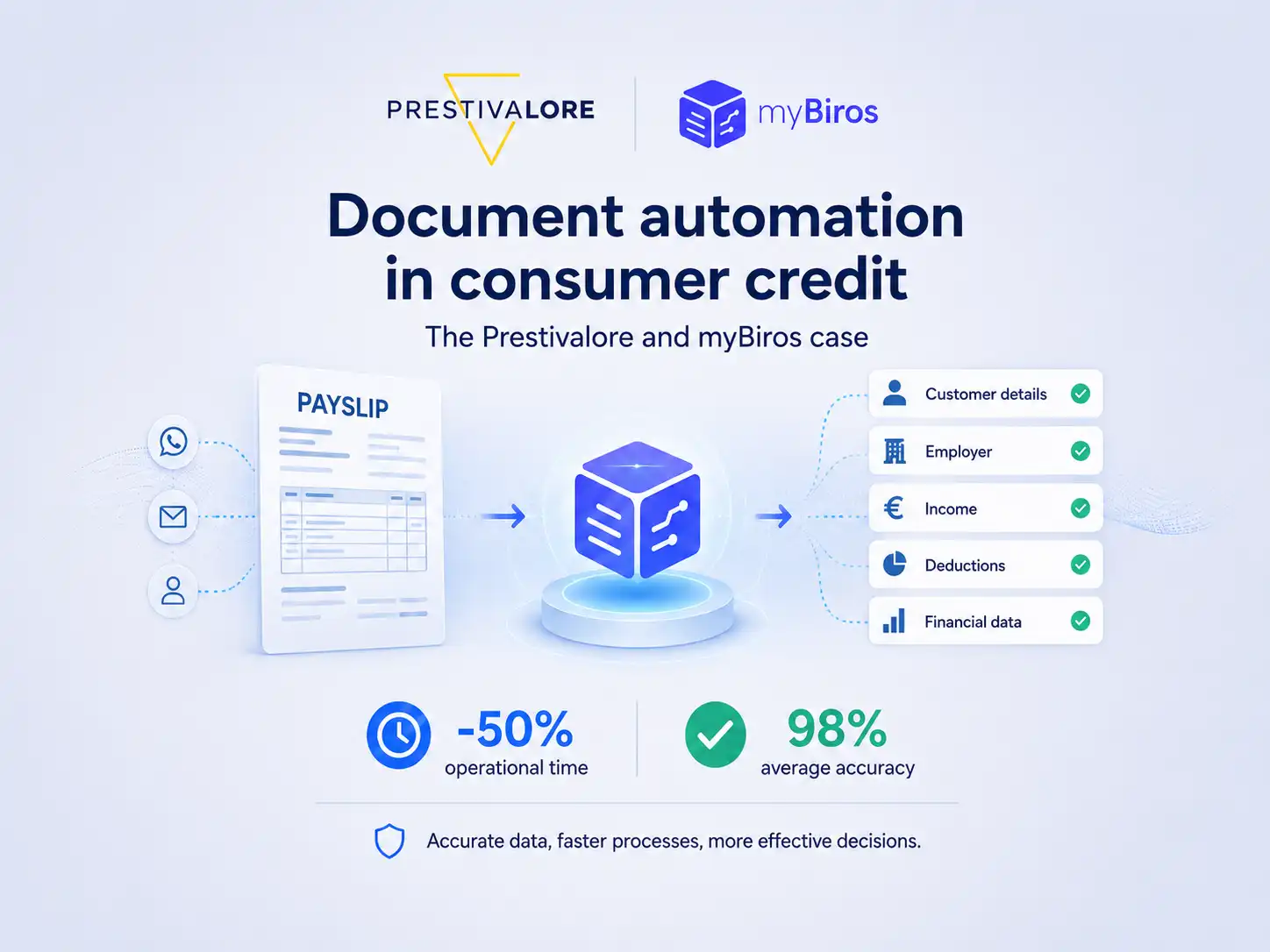
How Prestivalore reduced operational times by 50% with myBiros
Prestivalore processes approximately 90,000 documents each year, including payslips and identity documents. Thanks to myBiros, the company has automated data extraction, reduced manual work, and achieved an average accuracy rate of 98%.
Read it now
Beyond the Demo: The Hidden Complexities of Training and Validating VLMs for Document AI
Training a VLM for Document AI may look straightforward in a demo, but bringing it into production requires a robust pipeline: multimodal datasets, controlled fine-tuning, and reliable output validation.
Read it now

