


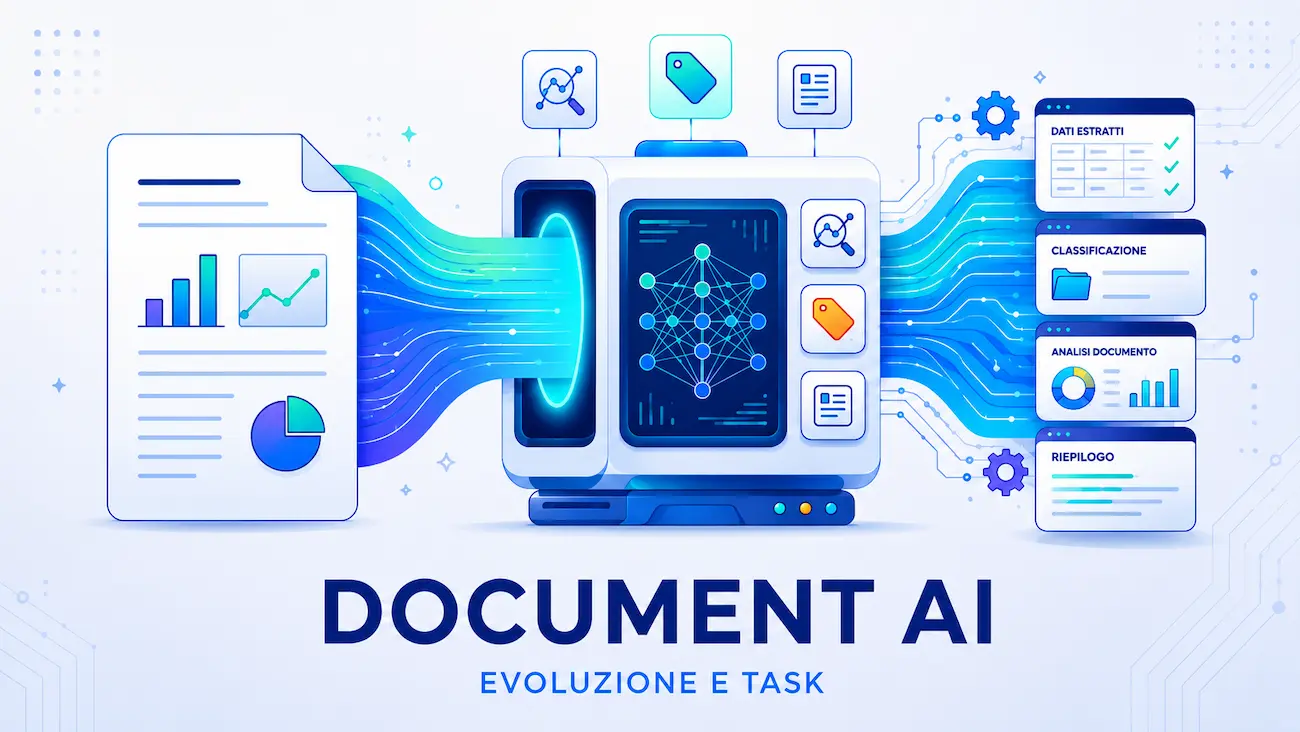
What Is Document AI? Its Evolution Over the Years and Main Tasks
Document AI represents the evolution of technologies designed to understand, classify, extract, and generate data from documents, from rule-based systems to multimodal models and complete IDP platforms.

Artificial Intelligence applied to documents, often referred to as Document AI, has radically transformed the way organizations process information and extract value from their archives and data. In an era where unstructured data represents the majority of business information, automating document extraction and data entry is no longer optional. It has become a necessity.
In this article, we will analyze the historical development of the technologies involved and the main operational applications.
The key topics covered include:
- the technological evolution of Document AI, from early rule-based approaches to modern Vision Language Models;
- Understanding tasks, focused on document comprehension;
- Generation tasks, focused on document content generation;
- why an AI model is only the “engine” and the advantages and disadvantages of a complete IDP platform.
The Evolution of Document AI: From Rule-Based Approaches to Generative AI
The field of Document AI has evolved over the years through several phases, moving from early manual systems to sophisticated multimodal generative architectures. This historical progression can be divided into four main stages:
- Early 1990s: heuristic approaches based on rigid rules.
Initially, early systems required manual observation of the layout in order to define the heuristic rules needed to process documents with strictly fixed templates. This was a mainly structural approach, based on spatial coordinates, and relied on algorithms such as X-Y cut, K-Nearest Neighbors, or KNN, and Voronoi diagrams. Although these solutions were useful for segmentation, they struggled significantly when processing complex layouts or visual noise, making them poorly scalable. - 2000s: statistical machine learning.
In the following decade, the field shifted toward data-driven pipelines trained on previously annotated data. The typical process took place in two steps: first, the image was segmented to obtain candidate regions; then, a classifier was applied to categorize those blocks, for example as text, table, or figure. Among the most widely used methods were Support Vector Machines, or SVMs, and Conditional Random Fields, or CRFs, which were frequently applied to Document Layout Analysis and Table Structure Recognition tasks. - 2010 to 2020: deep learning and pre-trained encoders.
The rise of deep learning introduced the powerful paradigm of “pre-training and fine-tuning.” Pipelines combined OCR systems with deep neural networks, or DNNs, such as Convolutional Neural Networks, or CNNs, and Graph Neural Networks, or GNNs. However, what truly changed the standards of the time was the emergence of layout-aware transformer encoders, such as LayoutLM, which were able to explicitly combine textual representations with two-dimensional spatial layout information, excelling at key information extraction. - From 2020 to today: generative small and large language models.
Today, the sector is experiencing the era of generative language models, which can follow complex instructions and adapt to a wide range of tasks. We are seeing a growing shift toward OCR-free workflows, capable of processing both digital and scanned documents with greater generalization capabilities, although sometimes with less robustness in highly specific cases. Among the most advanced current architectures are multimodal encoder-decoders, which combine layout, text, and computer vision into a single generative system with exceptional multilingual capabilities.
The Main Tasks of Document AI
Understanding processes is the foundation of automation. The tasks that belong to the field of Document AI can be grouped into two broad categories: Understanding tasks and Generation tasks.
Understanding Tasks
The goal of these tasks is to understand the content of a document in depth in order to extract useful knowledge from it.
- Key Information Extraction, or KIE: Key Information Extraction focuses on extracting essential information from unstructured or semi-structured documents, returning key-value pairs.
- Named Entity Recognition, or NER:
amed Entity Recognition classifies each individual entity found in the document, such as dates, organizations, people, and more, into the corresponding category. - Document Layout Analysis, or DLA: Document Layout Analysis identifies and classifies the structure of the document into logical segments, such as tables, text blocks, and images. It often acts as a fundamental preprocessing technique for more complex tasks.
- Document Classification: Document Classification aims to categorize the document being analyzed into one or more classes, using both its visual and textual content.
- Document Sentiment Analysis, or DSA: Document Sentiment Analysis aims to understand the “sentiment” or emotional tone of a document based on its textual content.
- Table Structure Recognition: table Structure Recognition consists of analyzing the structure of tables in order to understand the arrangement of cells, rows, columns, and headers within them.
- Extractive Document Q&A: given a question, or query, the model identifies the precise regions of the document from which the answer can be derived and extracted.
Generation Tasks
Starting from a given document, generation tasks aim to create new information or additional content.
- Generative Document Q&A: unlike the extractive variant, Generative Document Q&A aims to process the information contained in the document and generate a meaningful answer in natural language, contextualizing the document’s content.
- Document Summarization: Document Summarization automatically generates summaries of the original document content.
- Document Content Generation: Document Content Generation expands the original document by generating new content, for example by creating a table or chart that summarizes the text.
Beyond the Model: The Value of a Complete IDP Platform
Today, with the growing accessibility of Large Language Models, or LLMs, and open-source tools, many companies are tempted to develop their own Document AI solution internally. However, it is essential to understand a crucial distinction: an Artificial Intelligence model is only the engine, not the entire car.
While building an algorithm capable of extracting data in a test environment is now relatively simple, bringing that system into production while ensuring reliability at industrial scale is a completely different challenge.
Relying on a complete Intelligent Document Processing, or IDP, solution offers competitive advantages that are difficult to replicate internally:
- Accuracy and Model Maturity. Specialized IDP vendors refine their models on millions of real-world documents, dealing with every possible variation in layout and scan quality.
A non-specialized company is unlikely to have access to the same breadth of training data required to accurately manage edge cases. The out-of-the-box performance of a mature IDP platform consistently exceeds that of custom models built from scratch. - Uncertainty Management and Human-in-the-Loop. Since AI is not infallible, the real value of an IDP product lies in the workflows designed to manage errors.
Through ergonomic validation interfaces and Human-in-the-Loop processes, the platform automatically routes low-confidence data to a human operator.
Developing these routing systems and work queues internally requires months of engineering work that goes well beyond pure machine learning expertise. - Scalability and Infrastructure. Moving from processing a few dozen files to tens of thousands of documents per day requires a robust and resilient cloud architecture.
IDP platforms are designed from the ground up to scale, managing traffic peaks, resource balancing, and fault tolerance.
Maintaining a similar infrastructure internally involves operational costs, including DevOps and cloud computing, as well as a level of complexity that often outweighs the benefits of an in-house solution. - End-to-End Integration. The process does not end with data extraction. Information must be validated against company databases, for example by checking master data or verifying VAT numbers, and integrated into downstream systems such as ERP, CRM, or accounting software.
IDP solutions offer preconfigured connectors and advanced business logic, or business rules, to automate the entire flow: from incoming document to structured data ready to be used in the company’s management system.
Conclusion
Document AI has made enormous progress, moving from limited, manual, and highly non-scalable systems to intelligent and flexible platforms that integrate computer vision with natural language processing.
Today, automating information classification and extraction with the latest multimodal models means giving your company an essential competitive advantage.
However, the success of a document automation project is not measured only by the quality of the algorithm. It also depends on the ability to govern the entire process efficiently, scalably, and securely.
Do you want to optimize the management of your archives and turn your unstructured documents into value?
At myBiros, we have developed cutting-edge IDP solutions ready to integrate into your processes, offering you both a powerful AI engine and a complete infrastructure to bring it into production.
Contact us. We are ready to help you take the first step.
Articles in the same category

Digital sale of RCA insurance policies: how IDP improves quotes and onboarding
IDP makes it possible to automatically extract data from RCA insurance policies and use it to generate personalized quotes, reducing manual form filling and abandonment in the digital funnel.
Read it now
Document AI: when general-purpose model APIs are not enough
General-purpose model APIs work well for prototypes, but at scale, document data extraction requires validations, integrations, and exception handling. The model is only one part of the system.
Read it now
AI for Gas and Electricity Switching: Less Friction, More Contracts
Extracting data from utility bills and documents still slows down many switching processes. With myBiros’ specialized AI, utilities and sales networks can automate data entry, reduce errors and accelerate contract signing.
Read it now
Accelerating Time-to-Yes in Lending with AI
AI accelerates the analysis of financial documents, reduces manual work, and transforms data into structured information, enabling banks and financial intermediaries to respond faster and improve their Time-to-Yes.
Read it now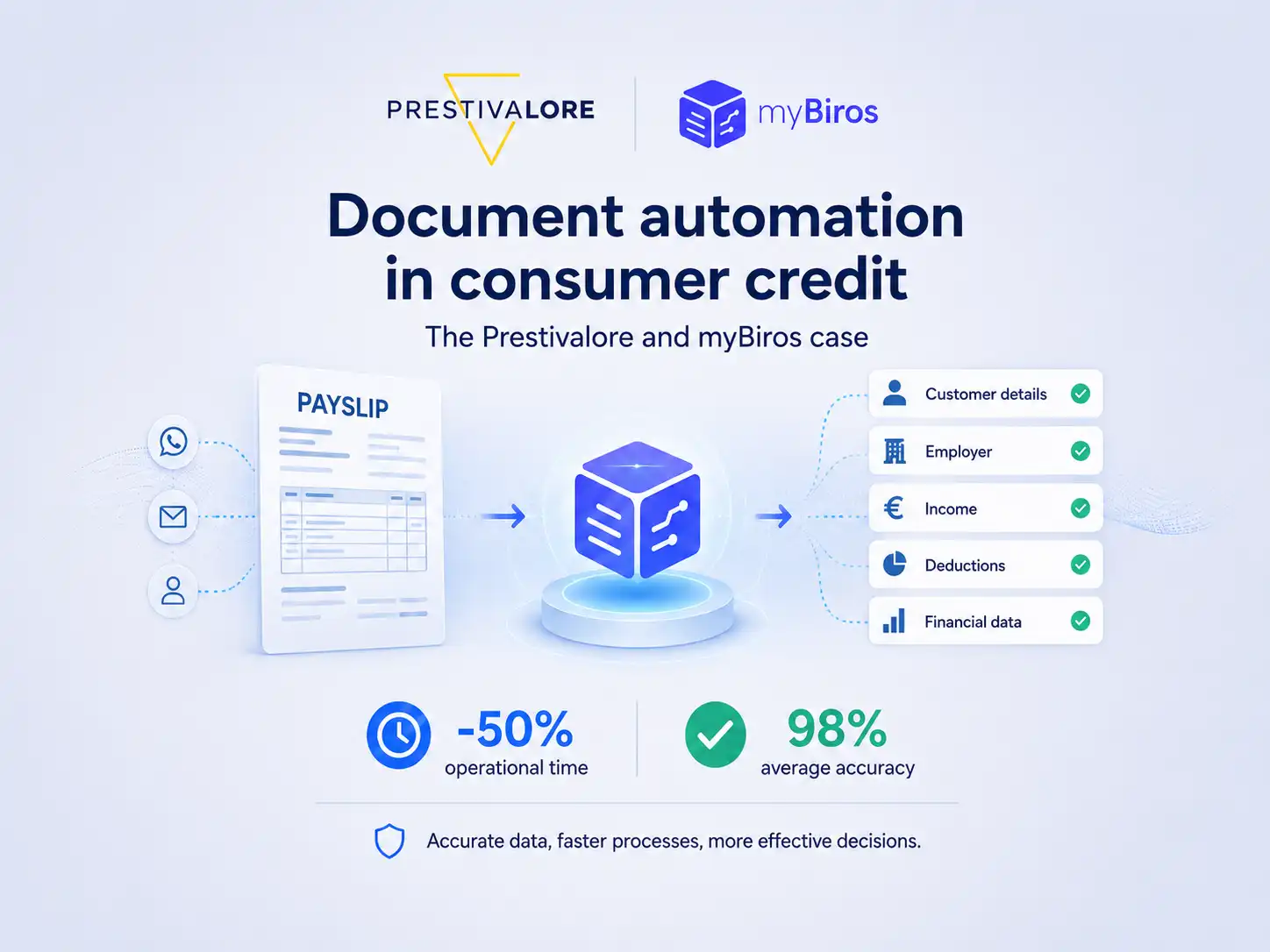
How Prestivalore reduced operational times by 50% with myBiros
Prestivalore processes approximately 90,000 documents each year, including payslips and identity documents. Thanks to myBiros, the company has automated data extraction, reduced manual work, and achieved an average accuracy rate of 98%.
Read it now
Beyond the Demo: The Hidden Complexities of Training and Validating VLMs for Document AI
Training a VLM for Document AI may look straightforward in a demo, but bringing it into production requires a robust pipeline: multimodal datasets, controlled fine-tuning, and reliable output validation.
Read it now


.svg)
.svg)
