



What is artificial intelligence and why is it important for businesses
Artificial intelligence helps businesses automate tasks, analyze data, manage documents, and make processes more efficient. In this article, we explore what AI is, how it works, and where it can generate real value within a company.

What Is Artificial Intelligence for Business?
Artificial intelligence is a set of technologies that enables software systems to analyze data, recognize patterns, generate responses, and support activities that would normally require human expertise.
In a business context, AI is not just a tool for creating text or chatbots. It is an enabling technology that can be integrated into operational, administrative, and decision-making processes, helping companies manage information, reduce repetitive tasks, and make workflows more scalable.
To understand its real value, it is useful to start with a simple distinction: artificial intelligence does not automatically replace a business process. It makes that process more efficient when it is integrated with reliable data, clear objectives, and the systems already in use within the company.
What Is Artificial Intelligence?
Artificial intelligence, often abbreviated as AI, is the ability of a computer system to perform tasks that would normally require human intelligence.
These tasks include:
- understanding natural language;
- recognizing images or documents;
- classifying information;
- identifying anomalies;
- making predictions;
- generating content;
- supporting operational decisions.
Traditional software follows explicitly defined instructions. An AI system, on the other hand, can learn from data and recognize patterns that have not been manually programmed in every detail.
This does not mean that AI “understands” in the same way a person does. It means that a mathematical model is able to associate inputs and outputs based on what it has learned during training.
How Artificial Intelligence Works
An artificial intelligence system is trained on data. During this phase, the model learns to recognize statistical relationships, patterns, and useful features that allow it to perform a specific task.
Once trained, the model can receive a new input and produce an output that is consistent with the task it was designed for.
For example:
- a classification model can determine whether a customer request is urgent or non-urgent;
- a predictive model can estimate the likelihood of a delivery delay;
- a language model can generate a response or summarize a text;
- a visual model can recognize elements within an image;
- a document processing system can help identify relevant information inside a business file.
One point is important to clarify: not all AI systems automatically improve while they are being used. Many models are trained before being put into production and then updated later through controlled cycles of retraining, validation, and monitoring.
In a business context, this distinction is essential. An AI system must be governed, measured, and controlled, especially when it works with sensitive data or critical processes.
The Main Families of Artificial Intelligence
Artificial intelligence is not a single technology. It is a set of different approaches that can be combined depending on the problem to be solved.
To make sense of it, it is useful to distinguish between two levels: techniques, meaning the methods through which an AI system learns and reasons, and application domains, meaning the types of problems those techniques are applied to.
Techniques: How an AI System Learns
Machine Learning
Machine learning is the foundational approach behind modern AI. It enables a model to learn from data instead of relying only on manually written rules.
It is used to classify information, make predictions, recognize anomalies, and identify recurring patterns. In business, it can be applied to customer segmentation, demand forecasting, automatic classification of requests or documents, and the detection of anomalous behavior.
Deep Learning
Deep learning is an advanced form of machine learning based on deep neural networks. It is particularly effective when data is complex and unstructured, such as text, images, audio, video, and documents.
Many of the most advanced AI systems developed in recent years, including language models and visual models, are based on deep learning architectures.
Application Domains: Which Problems AI Can Address
The techniques described above are used to tackle very different categories of problems. Three domains are especially relevant in business contexts.
Natural Language Processing
Natural Language Processing, often referred to as NLP, concerns the ability of an AI system to analyze, understand, classify, or generate text. It can be implemented using traditional machine learning techniques or, in more recent systems, deep learning models such as Large Language Models.
NLP is the foundation of chatbots, virtual assistants, semantic search systems, automatic summaries, and text analysis. In business, it is useful when large amounts of information are contained in emails, tickets, contracts, reports, or other unstructured communications.
Visual Analysis
Visual analysis, often called computer vision, allows AI systems to process content such as images, scans, photographs, and videos. Here too, the underlying techniques may vary, although today most advanced systems are based on deep learning.
In business, computer vision is used for quality control, object recognition, visual verification, and, in the case of documents, to recognize layouts, tables, and fields within business files.
Structured Data Analysis
Many business processes generate data that is already organized into tables, databases, or time series. In this domain, traditional machine learning often remains the most effective tool for tasks such as demand forecasting, financial anomaly detection, risk scoring, and segmentation.
Generative AI
Generative AI is a category of models capable of producing new content from an input: text, images, code, summaries, conversational responses, and structured outputs.
Unlike predictive or classification models, which return a label, a value, or a decision, a generative model produces something new. It does not simply say, “this document is an invoice”; it writes a text, generates a response, or fills in a field.
Technically, generative AI is a form of deep learning. Large Language Models, or LLMs, such as those behind ChatGPT or Claude, are the best-known example, but the same category also includes image generation models and multimodal models capable of reasoning over text and images together.
What Generative AI Can Do in Business
The value of generative AI in business is not only creative. It can be used to:
- answer questions about documents or internal knowledge bases;
- produce drafts of texts, emails, or reports;
- extract and structure information from unorganized content;
- support operators in verification or classification tasks;
- make interaction with complex systems easier through natural language.
One Point to Keep in Mind
Generative AI produces fluent and apparently coherent outputs, but it does not “know” whether what it generates is correct. For this reason, in business contexts where accuracy is critical, generative systems must be integrated with control mechanisms, validation processes, and human supervision.
Where AI Is Used in Companies
Artificial intelligence can be applied across many business areas.
Examples include:
- customer support and chatbots;
- predictive analysis for sales and demand;
- fraud and anomaly detection;
- automatic classification of emails and tickets;
- support in report generation;
- internal search across company knowledge bases;
- automation of administrative tasks;
- analysis of documents and unstructured information;
- support for decision-making and operational processes.
The key point is not to introduce AI everywhere, but to identify the processes where it can reduce time, errors, or complexity.
A strong AI use case usually has a few specific characteristics: available data, a repetitive activity, sufficient volume, measurable benefit, and the ability to control the results.
AI and Document Processes
One of the areas where artificial intelligence delivers concrete value is document management.
Many companies work every day with files received by email, through portals, via scans, manual uploads, or external systems. These documents contain important information, but that information is often not immediately usable by business software.
AI can help transform this content into data that is easier to classify, verify, and integrate.
In the case of Intelligent Document Processing, the goal is to automate parts of the document lifecycle: recognizing the document type, identifying relevant information, reducing manual data entry, and connecting the results to business systems.
This is where technologies such as OCR, computer vision, language models, document automation systems, and, in more advanced contexts, models capable of combining visual analysis and language understanding come into play. These include Vision Language Models, or VLMs, and Small Vision Language Models, or SVLMs. In this article, we mention them as part of the evolution of AI applied to documents, while a deeper technical discussion of OCR and vision-language models remains a specific topic to be addressed separately.
Why AI Is Not Just Automation
Artificial intelligence is often described as a tool for automating tasks. This is true, but it is an incomplete definition.
Traditional automation executes a predefined sequence of actions. AI adds the ability to work with variability, ambiguity, and data that is not always neatly organized.
This means AI can be useful when a process is not fully standardized, but includes exceptions, different formats, natural language, or information that is difficult to translate into rigid rules.
In real business processes, this feature is often decisive. Many activities are not complex because they require creativity, but because they require interpretation, comparison, control, and the management of exceptions.
Benefits of Artificial Intelligence for Businesses
The main benefits AI can bring to a business context include:
- Reduced processing times: activities that take hours can be handled in seconds or minutes;
- Scalability: an AI system can process growing volumes without a proportional increase in resources;
- Consistency: unlike a manual process, a model produces consistent outputs regardless of volume;
- Management of variability: AI can work with unstructured data, different formats, and cases that were not explicitly anticipated;
- Decision support: models can flag anomalies, priorities, or patterns that would be difficult to identify manually.
These benefits are not automatic. They depend on data quality, clear objectives, and the ability to integrate the AI system into a process that is already properly governed.
AI, Data, and Governance
The quality of an AI project depends largely on the quality of the data and the clarity of governance.
Before adopting an AI solution, a company should ask itself:
- what data is available;
- where that data is located;
- who can access it;
- how reliable it is;
- how it is updated;
- which outputs need to be produced;
- who checks the results;
- how exceptions and errors are handled.
Without these answers, the risk is to introduce an advanced technology into a process that is not ready to use it correctly.
For this reason, AI is not just a software choice. It is also an organizational choice.
Cloud, Infrastructure, and Integration
The cloud has made many artificial intelligence applications more accessible, because it allows companies to use computing power, storage, and scalable services without building the entire infrastructure internally.
For companies, however, the choice is not simply between cloud and non-cloud. They need to assess architecture, security, performance, compliance, integration with existing systems, and control over data.
Some projects can be managed in the public cloud, while others require private environments, hybrid architectures, or more controlled deployment models.
In document, administrative, or financial processes, these aspects are particularly important because the data being processed may be sensitive or subject to regulatory constraints.
How to Adopt AI in Business
The most effective approach is to start with a clearly defined use case.
A pilot project makes it possible to evaluate:
- data quality;
- process complexity;
- expected accuracy;
- processing times;
- operational impact;
- integration with existing tools;
- measurable return.
Only after this phase does it make sense to extend AI to other processes, departments, or data types.
In the case of documents, for example, a company can start with a single high-volume document category and then gradually expand the scope.
This approach reduces risk, makes it possible to measure real results, and helps the company build internal expertise.
Ethics, Security, and Regulation
The adoption of artificial intelligence involves technical, organizational, and regulatory responsibilities.
Companies must pay attention to privacy, security, human oversight, transparency, traceability, and output quality.
At the European level, the AI Act introduces a risk-based regulatory framework, with different requirements depending on the type of application and its impact.
Essential Glossary
Algorithm: a sequence of instructions or rules used to solve a problem.
AI model: a mathematical system trained to produce an output from an input.
Machine learning: an approach that enables a model to learn from data instead of relying only on manual rules.
Deep learning: a family of techniques based on deep neural networks, particularly effective with complex and unstructured data. It is an advanced form of machine learning.
NLP: Natural Language Processing, meaning the processing of natural language.
Computer vision: technology that makes it possible to analyze images, scans, and visual content.
Generative AI: a type of AI system specialized in producing new content from an input, such as text, images, code, summaries, and structured outputs. Unlike predictive or classification models, it produces something new instead of returning a label or value. It is the technology behind tools such as ChatGPT or Claude and is a form of deep learning.
LLM: Large Language Model, a large-scale language model based on deep learning and used in the main text-based generative AI systems.
Vision Language Model, or VLM: an AI model capable of combining visual and language inputs, useful when a system needs to analyze images, documents, or screens together with text instructions.
Small Vision Language Model, or SVLM: a more compact and customizable version of a Vision Language Model, useful in business contexts where efficiency, control, and adaptation to specific domains are required.
IDP: Intelligent Document Processing, meaning the intelligent processing of documents using AI and document automation technologies.
Conclusion: AI Becomes Useful When It Solves Real Problems
Artificial intelligence is a broad technology, but its value for companies emerges when it is applied to concrete processes.
Introducing a model or a generative tool is not enough. Companies need to identify an operational problem, understand which data is available, define success metrics, and integrate AI into a controlled workflow.
In document processes, this means using artificial intelligence to reduce manual tasks, improve information management, and make operations more scalable when they still depend heavily on manual reading, copying, and verification.
AI does not automatically replace the business organization. It makes the organization more effective when it is designed with method, governance, and measurable objectives.
The Role of myBiros in AI Applied to Documents
At myBiros, we apply artificial intelligence to business document processes by combining reading technologies, visual analysis, and content understanding to transform complex files into reliable and usable data.
The platform integrates OCR, computer vision, artificial intelligence models and, where needed, approaches based on Vision Language Models, or VLMs, and Small Vision Language Models, or SVLMs, within a broader Intelligent Document Processing workflow. In this way, the document is not treated simply as text to be captured, but as a set of information to be classified, interpreted, and validated.
The goal is to automate the most repetitive tasks related to document management: recognizing the type of document, identifying relevant data, reducing manual data entry, and making information available to ERP, CRM, management systems, and business workflows.
The approach is designed for real-world documents, which are often variable and not perfectly standardized, such as utility bills, identity cards, passports, payslips, forms, and operational files.
In this way, AI enters document workflows in a concrete way: reducing processing times, manual errors, and operational complexity, while maintaining control over data and exceptions.
Do you want to understand how artificial intelligence can be applied to your document processes? Contact us or book a myBiros demo.
Articles in the same category

Digital sale of RCA insurance policies: how IDP improves quotes and onboarding
IDP makes it possible to automatically extract data from RCA insurance policies and use it to generate personalized quotes, reducing manual form filling and abandonment in the digital funnel.
Read it now
Document AI: when general-purpose model APIs are not enough
General-purpose model APIs work well for prototypes, but at scale, document data extraction requires validations, integrations, and exception handling. The model is only one part of the system.
Read it now
AI for Gas and Electricity Switching: Less Friction, More Contracts
Extracting data from utility bills and documents still slows down many switching processes. With myBiros’ specialized AI, utilities and sales networks can automate data entry, reduce errors and accelerate contract signing.
Read it now
Accelerating Time-to-Yes in Lending with AI
AI accelerates the analysis of financial documents, reduces manual work, and transforms data into structured information, enabling banks and financial intermediaries to respond faster and improve their Time-to-Yes.
Read it now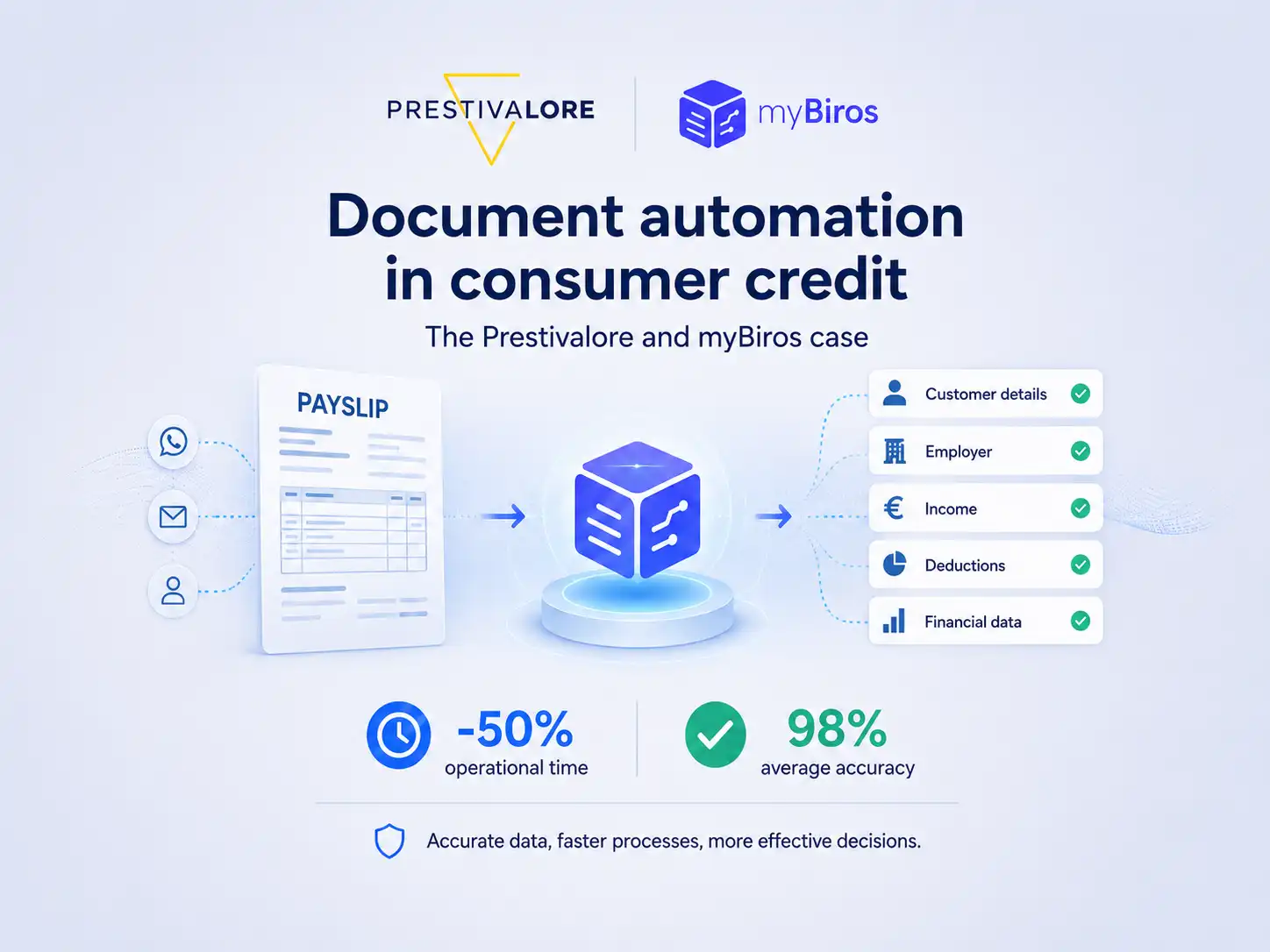
How Prestivalore reduced operational times by 50% with myBiros
Prestivalore processes approximately 90,000 documents each year, including payslips and identity documents. Thanks to myBiros, the company has automated data extraction, reduced manual work, and achieved an average accuracy rate of 98%.
Read it now
Beyond the Demo: The Hidden Complexities of Training and Validating VLMs for Document AI
Training a VLM for Document AI may look straightforward in a demo, but bringing it into production requires a robust pipeline: multimodal datasets, controlled fine-tuning, and reliable output validation.
Read it now


.svg)
.svg)
