


Make or buy in IDP: how to choose the right document automation solution
Build or buy an IDP platform? a practical guide to assessing costs, timelines, scalability, and risks when choosing the best document automation solution.

Today, we address one of the most common (and complex) dilemmas for IT and Operations leaders looking to automate document management: is it better to build an IDP (Intelligent Document Processing) solution in-house or buy a ready-made platform?
The decision should not start with the question “which model extracts fields better?”, but from a broader perspective: which option makes it possible to produce reliable, validated data that is integrated into business processes with the lowest operational risk and the best Total Cost of Ownership (TCO)?
The global IDP market exceeded $8 billion in 2024 and is growing at a remarkable pace. In this context, the advantage is quickly shifting from building individual components to buying an industrialized capability. Let’s explore why.
The extraction illusion: why a prototype is not enough
Many companies fall into what analysts call the “extraction trap.” With the rise of Large Language Models (LLMs), extracting text from a document may seem like a solved problem. However, extraction is only one step in a much broader process.
Modern IDP is not the same as simple OCR or the isolated use of a generative model. A mature production system must:
- Receive heterogeneous documents and classify them automatically.
- Understand layout and content beyond the logic of fixed templates.
- Extract information while providing a reliable confidence score for each field.
- Manage exceptions and enable targeted human review through a human-in-the-loop approach.
- Deliver structured data to ERP, CRM, and business systems without bottlenecks.
The real make-or-buy decision concerns the entire industrial chain: data, models, validation, monitoring, compliance, integrations, and long-term maintenance.
The 3 alternatives on the table
There is no universally superior solution. The right choice depends on document stability, process criticality, internal expertise, and scalability goals.
A. Building with open-source models (make). This is the option that provides the highest level of control over code, infrastructure, and data. The downside is that it requires strong AI expertise, annotated datasets, training pipelines, MLOps, a validation interface, and continuous maintenance. Time-to-value is long, because everything is built from scratch.
B. Hybrid / composable approach (build on API/LLM). This approach enables rapid prototyping by orchestrating generic LLMs or cloud AI services with proprietary validation layers. However, in production, the responsibility for orchestration, security, variable cost management, and integration with core systems remains entirely with the company. Prototype speed does not automatically translate into operational maturity.
C. Buying an IDP platform (buy). This ensures the fastest time-to-value thanks to already integrated capabilities: specialized models, often optimized Small Vision Language Models, validation workflows, confidence scores, connectors, and governance. It does involve dependency on the vendor, with a potential risk of lock-in, which should be assessed through real benchmarks on the company’s own documents and by analyzing licensing costs at scale.
The cost iceberg: the real Total Cost of Ownership (TCO)
When evaluating the “make” option, it is easy to focus only on the tip of the iceberg: the cost of APIs or cloud computing. However, industry analyses show that the true cost of an IDP system built in-house is dominated by hidden expenses:
- Technical team: a minimum team to maintain an in-house IDP system requires MLOps engineers, data scientists, and dedicated developers, with salary costs that can easily exceed $100K per year.
- Infrastructure and MLOps: maintaining and updating models over time to manage model drift, as accuracy declines as document formats evolve.
- Exception management: the operational cost of manually handling edge cases not covered by the custom model.
Recent studies on 5-year TCO show that buying a mature platform can generate an ROI of more than 250% compared with in-house development, while drastically reducing the engineering burden.
The full picture before deciding
The following table compares the alternatives across the dimensions that matter most when moving from experimentation to production.
Checklist: are you ready for make or buy?
Answer these questions to guide your choice. Each “yes” in the buy column is a signal that a mature IDP platform could be the right path for your organization.
If you have 3 or more ✅ in the buy column, choosing a mature IDP platform is likely to deliver the best balance between time-to-value and Total Cost of Ownership.
Conclusion
Building makes sense when the strategic advantage lies in the IDP technology itself. Buying makes sense when the strategic advantage lies in quickly using reliable document data to improve processes, decisions, and business automation while optimizing TCO.
For example, in accounts payable processes, such as invoicing, or customer onboarding in Finance and Insurance, companies that adopt mature platforms can drastically reduce implementation times compared with in-house development.
If your goal is to turn documents into ready-to-use data while reducing manual work and operational costs, the myBiros platform is designed exactly for that. Built on 10 years of AI R&D and hosted on servers located in Europe for maximum privacy, our platform offers a transparent “buy” approach. With more than 20 million documents processed and an average accuracy of 98%, measured at single-field level in real-world operational contexts, we provide control, traceability through visual grounding, and immediate integration.
👉 Want to evaluate our platform on your real documents? Book a demo with our experts and discover how myBiros can adapt to your business.
Articles in the same category

Digital sale of RCA insurance policies: how IDP improves quotes and onboarding
IDP makes it possible to automatically extract data from RCA insurance policies and use it to generate personalized quotes, reducing manual form filling and abandonment in the digital funnel.
Read it now
Document AI: when general-purpose model APIs are not enough
General-purpose model APIs work well for prototypes, but at scale, document data extraction requires validations, integrations, and exception handling. The model is only one part of the system.
Read it now
AI for Gas and Electricity Switching: Less Friction, More Contracts
Extracting data from utility bills and documents still slows down many switching processes. With myBiros’ specialized AI, utilities and sales networks can automate data entry, reduce errors and accelerate contract signing.
Read it now
Accelerating Time-to-Yes in Lending with AI
AI accelerates the analysis of financial documents, reduces manual work, and transforms data into structured information, enabling banks and financial intermediaries to respond faster and improve their Time-to-Yes.
Read it now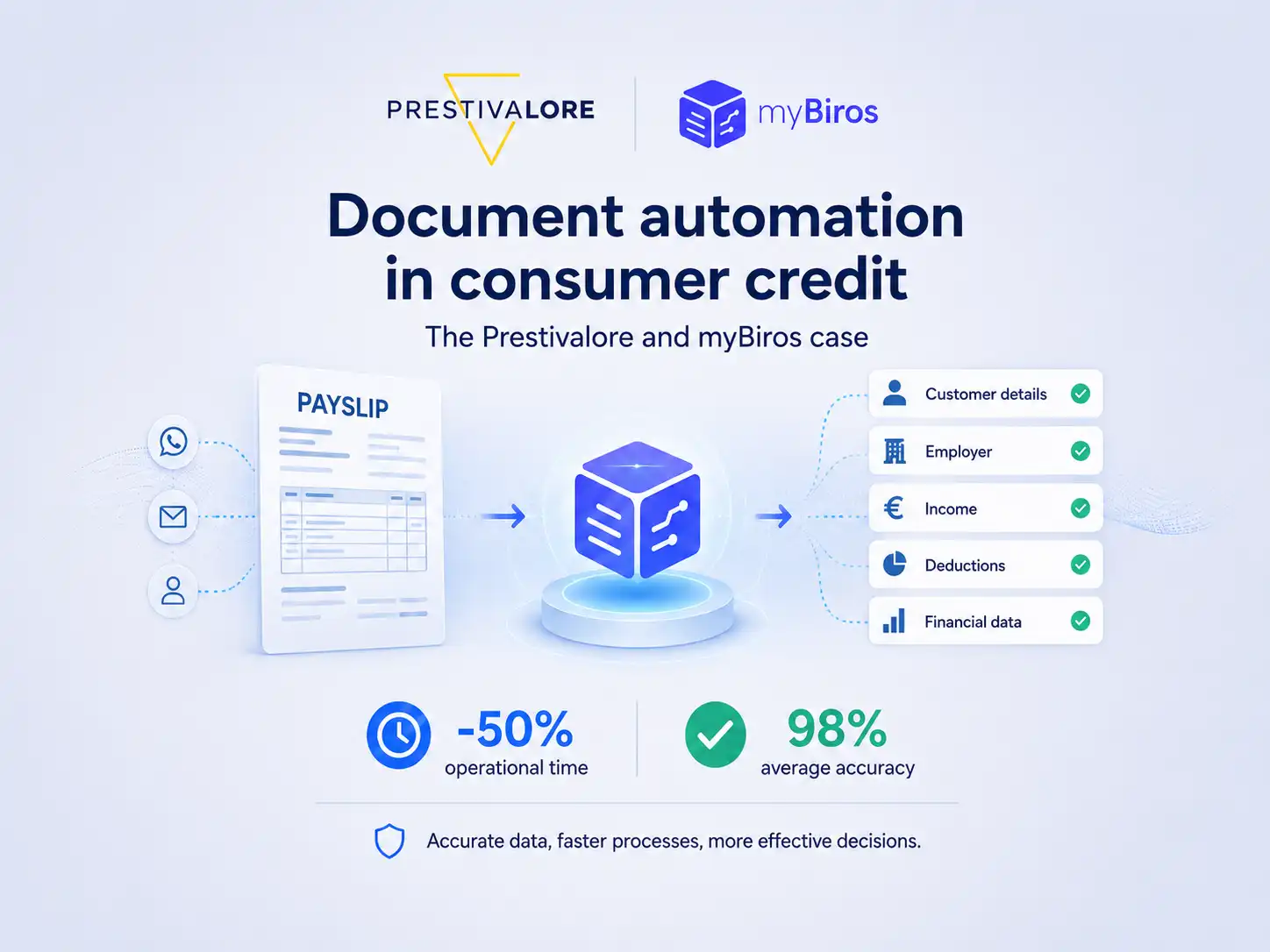
How Prestivalore reduced operational times by 50% with myBiros
Prestivalore processes approximately 90,000 documents each year, including payslips and identity documents. Thanks to myBiros, the company has automated data extraction, reduced manual work, and achieved an average accuracy rate of 98%.
Read it now
Beyond the Demo: The Hidden Complexities of Training and Validating VLMs for Document AI
Training a VLM for Document AI may look straightforward in a demo, but bringing it into production requires a robust pipeline: multimodal datasets, controlled fine-tuning, and reliable output validation.
Read it now


.svg)
.svg)
