


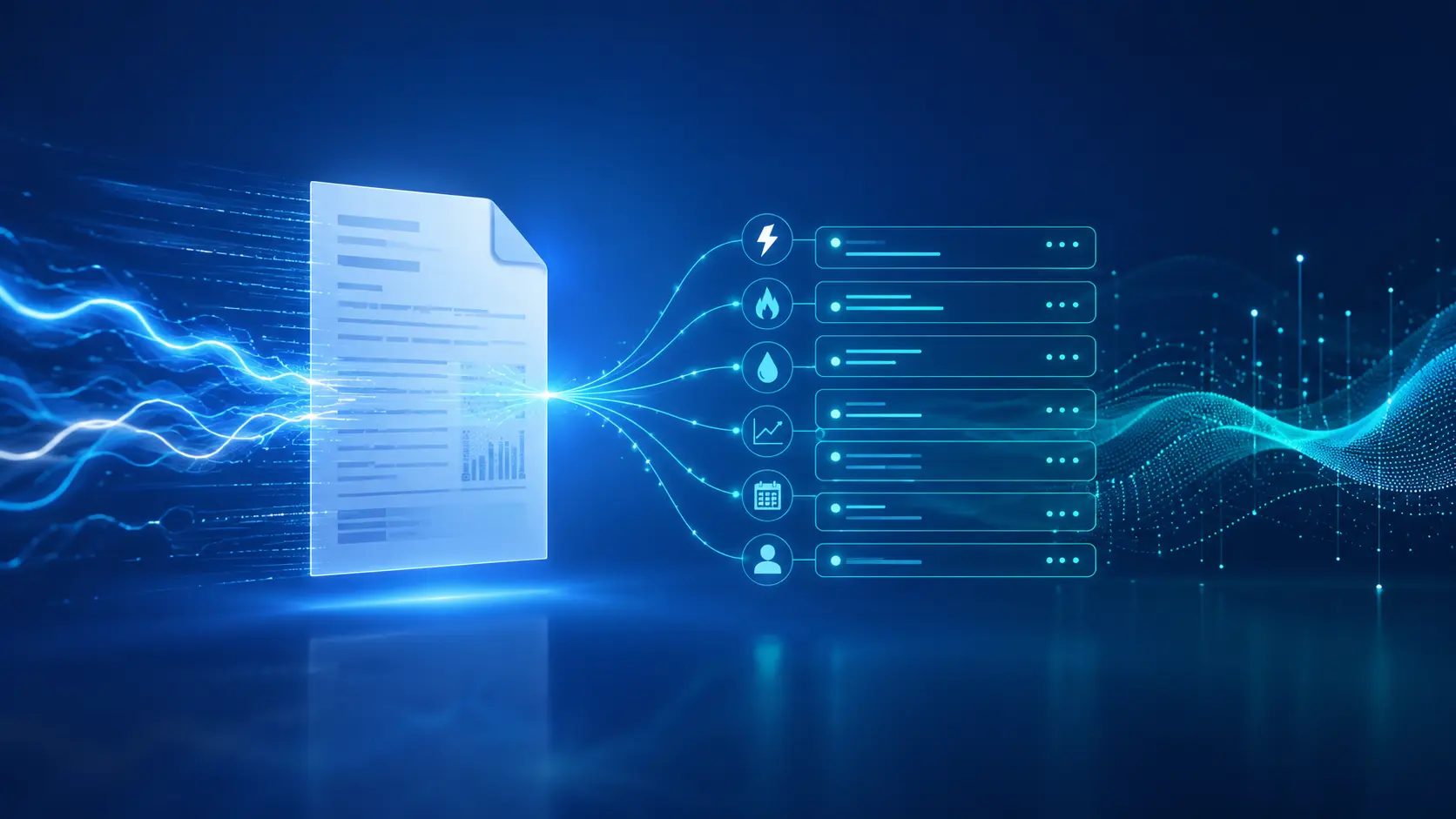
AI for Gas and Electricity Switching: Less Friction, More Contracts
Extracting data from utility bills and documents still slows down many switching processes. With myBiros’ specialized AI, utilities and sales networks can automate data entry, reduce errors and accelerate contract signing.

In the energy market, acquiring a new customer does not depend solely on how competitive the offer is. The simplicity of the sign-up process can also determine whether a conversion is completed or abandoned.
When switching gas or electricity providers, customers often need to retrieve a bill, identify multiple pieces of information, fill in forms and manually enter details such as the POD code, PDR code, account holder, address, tax code and contract information.
Every additional step introduces friction.
In digital channels, a lengthy process may lead users to abandon the sign-up. In physical channels, manual data entry slows down agents and increases the risk of errors.
Intelligent Document Processing makes it possible to transform utility bills, identity documents and company registry extracts into structured, verifiable data that can be immediately used in business systems.
The result is a faster, simpler and more reliable switching funnel.
Why switching processes are still inefficient
Switching providers involves information coming from different documents, often characterized by non-standardized layouts.
An electricity or gas bill may contain dozens of pieces of information, but only some are actually needed to start a new contract. The problem is that the position, label and format of this data vary from one provider to another.
The customer or operator therefore has to manually identify:
- POD or PDR code;
- account holder’s first and last name;
- tax code or VAT number;
- supply address;
- type of utility;
- previous provider information;
- consumption information;
- payment method information.
This seemingly simple task can become a critical point in the entire sales process.
Friction in the digital funnel
On web or mobile channels, users generally need to read the bill and copy the data into multiple fields.
Manual data entry can result in:
- transcription errors;
- incomplete fields;
- incorrect codes being entered;
- difficulty finding the required information;
- abandonment of the process before sign-up is completed.
The problem becomes more significant when customers use a smartphone, have to constantly switch between the bill and the form, or are unfamiliar with the technical meaning of the required fields.
Long processing times in the sales network
In physical channels, the same issues are transferred to agents.
The operator receives a photo, scan or PDF of the bill and has to manually transfer the data into the CRM or sales system.
This process reduces the time agents can dedicate to the customer relationship and increases the likelihood of incorrect information being entered.
A single error in the POD code, tax code or supply address can lead to additional checks, stalled applications and delays in contract activation.
How AI applied to gas and electricity switching works
An Intelligent Document Processing platform uses artificial intelligence models to understand document content and transform it into structured information.
The process can be divided into five main stages.
1. Document acquisition
The customer or agent uploads a bill in PDF format or takes a photo using a smartphone.
The system can receive the document from different points in the funnel:
- website;
- mobile application;
- customer portal;
- agent portal;
- CRM;
- document management system;
- email or support channels.
2. Automatic classification
AI recognizes the type of document that has been uploaded.
For example, it can distinguish an electricity bill from a gas bill, an identity card from a passport, or a company registry extract from another business document.
Classification makes it possible to apply the most appropriate extraction model.
3. Data extraction
The system identifies the relevant fields even when the position of the information varies from one document to another.
In the case of a utility bill, it can automatically extract:
- POD or PDR;
- account holder;
- tax code;
- VAT number;
- supply address;
- customer number;
- consumption data;
- contract type;
- payment information.
This is not simply about reading text using OCR. The model must understand the meaning of the data and correctly associate each value with the relevant field.
4. Information validation
Extracted data can be checked using configurable rules.
The system can verify:
- length and format of the POD or PDR code;
- formal validity of the tax code;
- consistency between the account holder and identity document;
- presence of mandatory fields;
- document quality;
- extraction confidence level.
A confidence score can be assigned to each piece of information to determine whether the data can be processed automatically or needs to be reviewed by an operator.
5. Integration with CRM and sales systems
Once extracted and validated, the data is sent directly to the CRM, management system or sign-up platform.
The form can therefore be pre-filled without requiring the customer or agent to manually copy the information.
Digital funnel: from bill to quote in just a few seconds
In a self-service process, uploading the bill can replace a large portion of manual form filling.
The customer uploads the document and the system automatically identifies the data required to analyze the supply and prepare an offer.
The user only needs to verify the extracted information and, where necessary, complete the few missing fields.
This approach makes it possible to create an experience similar to that of the most advanced digital services: fewer fields, fewer steps and fewer opportunities for error.
Automatic pre-filling
Pre-filling reduces the effort required from users and makes the process accessible even to those who are unfamiliar with terms such as POD, PDR or contracted power.
Faster comparison
Consumption data extracted from the bill can be used to propose offers that are more aligned with the customer’s profile.
Reduced drop-offs
By eliminating the most complex steps, the likelihood of users abandoning the process before submitting their request is reduced.
Better mobile experience
The ability to take a photo of the bill is particularly effective in smartphone funnels, where filling in long forms is one of the main sources of friction.
Physical funnel: greater productivity for agents and sales networks
Document automation also delivers significant benefits in assisted sales.
Agents can take a photo of the customer’s bill or upload the document they have received. AI extracts the information and transfers it directly into the sales system.
This allows consultants to focus on presenting the offer instead of spending time entering data.
Fewer repetitive tasks
Manual transcription is replaced by an automated process, leaving the operator responsible only for the final verification.
Contracts closed faster
Data is available during the visit or sales call, making it possible to complete the application without waiting for subsequent back-office processing.
Fewer transcription errors
Automatic extraction, combined with validation rules, reduces errors that could block the switching request.
Data immediately available in the CRM
Information can be sent to central systems in real time, avoiding intermediate files, emails, spreadsheets and duplicate data entry.
B2C and B2B switching: different document requirements
The technology can be applied to both residential and business utilities, but the two segments have different characteristics.
Switching in the B2C segment
In the consumer market, the priority is to minimize the time required to complete the sign-up.
The main documents are generally:
- electricity bill;
- gas bill;
- identity card;
- health insurance card or tax code document;
- bank account document.
The system must handle large volumes, guarantee fast response times and provide a simple experience even on smartphones.
Switching in the B2B segment
In the business market, the process may involve multiple utilities, different locations and a larger number of documents.
In addition to utility bills, the following may be required:
- company registry extracts;
- documents relating to the legal representative;
- tax codes and VAT numbers;
- powers of attorney;
- lists of supply points;
- company administrative documentation.
In this scenario, managing multi-site documents, verifying the completeness of the application and configuring specific rules for each customer or process become particularly important.
The benefits of Intelligent Document Processing for utilities
Automating document acquisition generates benefits throughout the entire sales funnel.
Reduced processing times
Automatic extraction makes it possible to acquire in just a few seconds information that would otherwise require several minutes of manual work.
In properly configured processes, processing times can be reduced by up to 70%.
Elimination of repetitive tasks
Many data-entry activities can be automated, reducing the manual work associated with reading and transcribing documents by up to 90%.
Greater data accuracy
The use of specialized models, confidence scores and configurable checks can increase extraction accuracy to as much as 97%, depending on the type and quality of the documents being processed.
Faster time-to-revenue
A complete and accurate application can be processed more quickly, reducing the time between customer acquisition and contract activation.
Increased conversion
A shorter and simpler funnel can reduce drop-offs and increase the number of users who complete the sign-up.
Higher data quality
Automatic validation helps identify missing, inconsistent or low-confidence information before the application is sent to downstream systems.
Operational scalability
The company can process a larger number of documents without proportionally increasing the number of back-office staff.
Why a specialized model is different from traditional OCR
Traditional OCR converts an image of a document into text. However, this is not enough to automate a switching process.
The platform needs to understand that a particular sequence represents the POD code, that another value corresponds to the supply address and that an amount refers to consumption or the total bill.
myBiros’ specialized models are trained to interpret complex documents and return data already organized according to the structure required by the business process.
This makes it possible to handle:
- different layouts;
- imperfect scans;
- smartphone photos;
- multi-page documents;
- fields appearing in different positions;
- information expressed using different labels;
- checks specific to the utility sector.
Integration into existing processes
Adopting an IDP solution does not necessarily require replacing the CRM or sales system.
The platform can be integrated via API into the processes already used by the company.
A possible operational flow includes:
- uploading the bill;
- classifying the document;
- extracting the data;
- automatically validating the data;
- requesting confirmation from the customer or agent;
- transferring the information to the CRM;
- completing the sign-up.
The integration can be customized according to the channel, customer segment and the utility’s operational rules.
From document management to an intelligent funnel
AI applied to documents is not simply a tool for saving time.
It makes it possible to redesign the entire acquisition process.
The bill becomes the starting point of an intelligent funnel: the document is uploaded, interpreted and transformed into data that can be used to compare offers and create the new contract.
The customer fills in fewer fields. The agent reduces administrative work. The back office receives more complete applications. The company accelerates the acquisition process and improves information quality.
Automate gas and electricity switching with myBiros
myBiros develops Intelligent Document Processing solutions based on models specialized in data extraction and validation.
The platform can process utility bills, identity documents, company registry extracts and other documents required in B2C and B2B acquisition processes.
Thanks to integration with CRMs, portals and sales systems, data can be made available in real time, eliminating manual data entry and reducing errors.
Want to make your switching funnel faster? Contact myBiros to assess a use case based on your documents.
FAQ
What is switching in the energy market?
Switching is the process through which a customer changes their electricity or gas provider. It requires the collection of information relating to the account holder, the supply point and the existing contract.
What data can be automatically extracted from a utility bill?
POD code, PDR code, account holder, tax code, supply address, customer number, consumption, contracted power and other information useful for comparison and sign-up can be extracted automatically.
Can AI also process photos taken with a smartphone?
Yes. The system can process images and PDFs, assess document quality and flag any issues that prevent reliable extraction.
Can the platform be integrated with a CRM?
Yes. Extracted data can be transferred via API to the CRM, management system, agent portal or platform used for sign-up.
Is the solution also suitable for business utilities?
Yes. In the B2B segment, it can handle multi-site utility bills, company registry extracts, documents relating to legal representatives and other information required for business supplies.
What is the difference between OCR and Intelligent Document Processing?
OCR recognizes the text contained in a document. Intelligent Document Processing also identifies the type and meaning of the information, validates it and returns it in a structured format that can be used by business systems.
Articles in the same category
Digital sale of RCA insurance policies: how IDP improves quotes and onboarding
IDP makes it possible to automatically extract data from RCA insurance policies and use it to generate personalized quotes, reducing manual form filling and abandonment in the digital funnel.
Read it now
Document AI: when general-purpose model APIs are not enough
General-purpose model APIs work well for prototypes, but at scale, document data extraction requires validations, integrations, and exception handling. The model is only one part of the system.
Read it nowAI for Gas and Electricity Switching: Less Friction, More Contracts
Extracting data from utility bills and documents still slows down many switching processes. With myBiros’ specialized AI, utilities and sales networks can automate data entry, reduce errors and accelerate contract signing.
Read it now
Accelerating Time-to-Yes in Lending with AI
AI accelerates the analysis of financial documents, reduces manual work, and transforms data into structured information, enabling banks and financial intermediaries to respond faster and improve their Time-to-Yes.
Read it now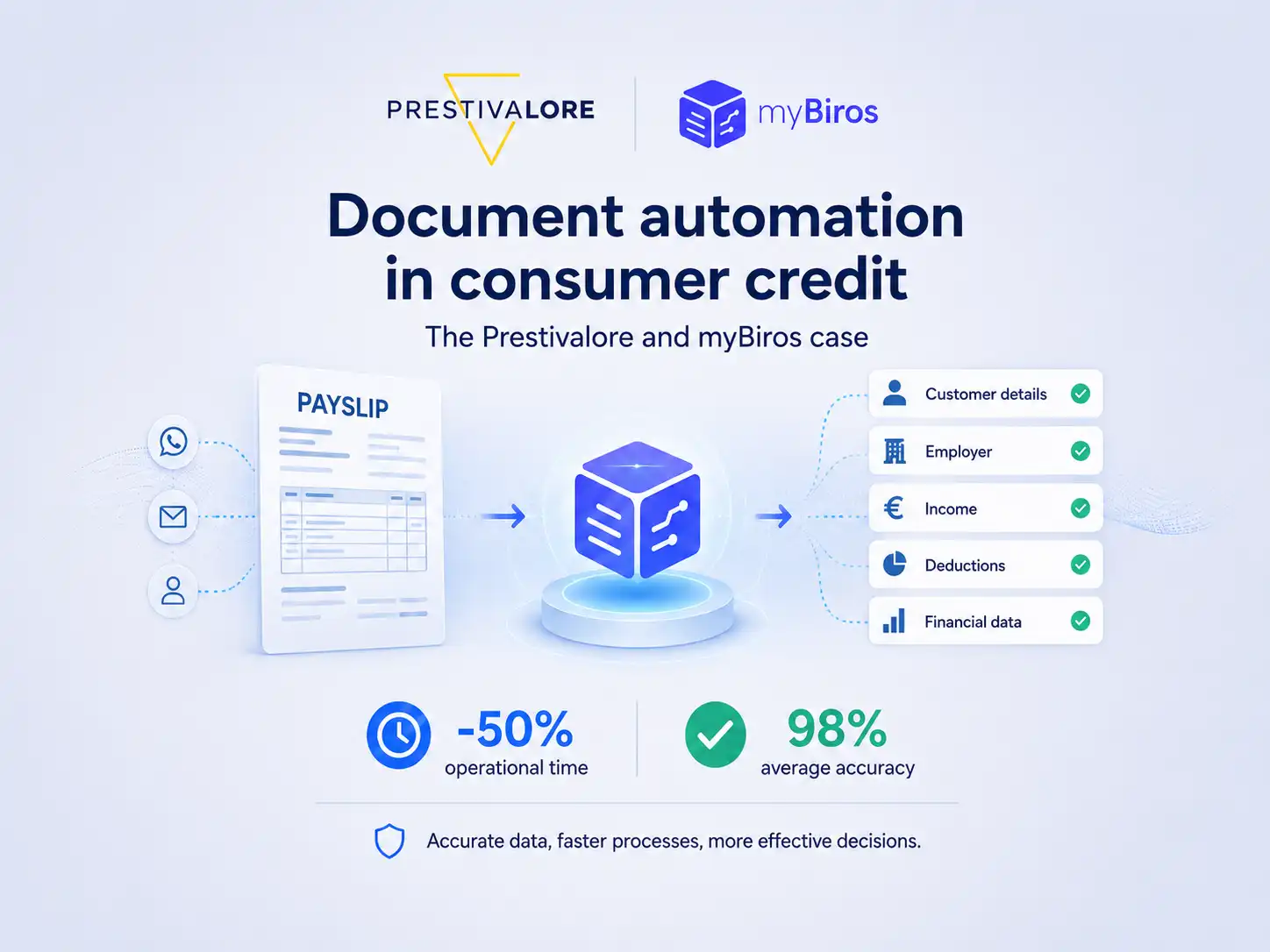
How Prestivalore reduced operational times by 50% with myBiros
Prestivalore processes approximately 90,000 documents each year, including payslips and identity documents. Thanks to myBiros, the company has automated data extraction, reduced manual work, and achieved an average accuracy rate of 98%.
Read it now
Beyond the Demo: The Hidden Complexities of Training and Validating VLMs for Document AI
Training a VLM for Document AI may look straightforward in a demo, but bringing it into production requires a robust pipeline: multimodal datasets, controlled fine-tuning, and reliable output validation.
Read it now


.svg)
.svg)
