


Risks of Manual Document Processing
Every business department relies on document management to record information, communicate with customers and suppliers, and store critical data. When done manually, these activities expose the company to numerous risks.
Every business department relies on document processing, which is essential to the company’s operations. Documents are used to record vital information, communicate with customers and suppliers, and store important data. However, when document processing is performed manually, it introduces a series of risks for companies, as it requires human intervention to manage all aspects of document handling - including receiving, classifying, extracting key information, and archiving.
Manual processing compromises the efficiency, accuracy, and security of the valuable information contained within these documents. Let’s explore the risks associated with manual document processing that companies face.
Errors and inaccurate data
One of the main risks associated with manual document processing is human error. Human error can lead to incorrect or inaccurate data. Regardless of employee skills, manual document processing always carries the risk of typing mistakes.
These errors can have significant consequences for the company, both from a technical and a financial standpoint. For instance, if the management system contains inaccurate data, supplier payments may be delayed or incorrect amounts may be processed.
Moreover, identifying these errors is a major challenge—such mistakes are often difficult to spot, leading to additional time and resource expenditure.
Time and human resources
Manual document processing demands a considerable investment of both time and human resources. Employees dedicated to these tasks spend a significant amount of time and energy, leading to a noticeable decline in overall efficiency and productivity.
Additionally, as mentioned earlier, identifying and correcting errors in documents requires even more time, further reducing process efficiency.
Security risks
Manual document processing also exposes the company to significant security risks.
In a manual process, sensitive documents may become accessible to unauthorized individuals or could be misplaced or lost during handling. Such scenarios compromise the confidentiality of business information and sensitive data, putting the company's reputation at serious risk.
Difficulty retrieving documents
With manual document processing, locating and retrieving necessary information can be complex and time-consuming. Without an efficient filing and indexing system, finding specific documents or relevant data often requires significant time and resources, leading to delays and inefficiencies. This challenge directly impacts the company's overall efficiency and productivity.
Automation: Intelligent Document Processing
How can automation help reduce the risks associated with manual document processing? With Intelligent Document Processing (IDP), it is possible to automate repetitive tasks related to document workflows and mitigate all the risks associated with manual processes.
By adopting a solution like Intelligent Document Processing, your company can effectively address these challenges:
- Reduce Human Errors: Automated systems perform repetitive tasks with high precision, significantly minimizing human error and ensuring data accuracy.
- Improve Operational Efficiency: Automation reduces the time and resources needed to manage documents. All processes are completed more efficiently and quickly, allowing businesses to reduce time spent on tasks and boost productivity. Additionally, automation simplifies processes, eliminating unnecessary steps and optimizing workflows.
- Reduce Security Risks: Automation enhances document security by minimizing the risks of unauthorized access or data loss. Automated solutions allow you to implement stringent access controls, ensuring that only authorized personnel can access sensitive documents. Moreover, automation can incorporate encryption and advanced security measures to safeguard data during document processing and storage.
- Simplify Regulatory Compliance: Intelligent Document Processing facilitates regulatory compliance by streamlining document management and ensuring traceability of all changes. These systems often include tracking capabilities that monitor document-related activities, track modifications, and generate reports to demonstrate compliance with privacy regulations and other legal requirements.
As highlighted, automation brings numerous benefits to document processing. It not only helps to mitigate the risks associated with manual handling but also improves the efficiency and security of business operations. By adopting automated solutions like Intelligent Document Processing, companies can optimize existing processes, reduce errors, and achieve higher efficiency and productivity.
Want to learn how to overcome the risks of manual document processing using Artificial Intelligence? Contact us today, we’re excited to help you!
Articles in the same category

Digital sale of RCA insurance policies: how IDP improves quotes and onboarding
IDP makes it possible to automatically extract data from RCA insurance policies and use it to generate personalized quotes, reducing manual form filling and abandonment in the digital funnel.
Read it now
Document AI: when general-purpose model APIs are not enough
General-purpose model APIs work well for prototypes, but at scale, document data extraction requires validations, integrations, and exception handling. The model is only one part of the system.
Read it now
AI for Gas and Electricity Switching: Less Friction, More Contracts
Extracting data from utility bills and documents still slows down many switching processes. With myBiros’ specialized AI, utilities and sales networks can automate data entry, reduce errors and accelerate contract signing.
Read it now
Accelerating Time-to-Yes in Lending with AI
AI accelerates the analysis of financial documents, reduces manual work, and transforms data into structured information, enabling banks and financial intermediaries to respond faster and improve their Time-to-Yes.
Read it now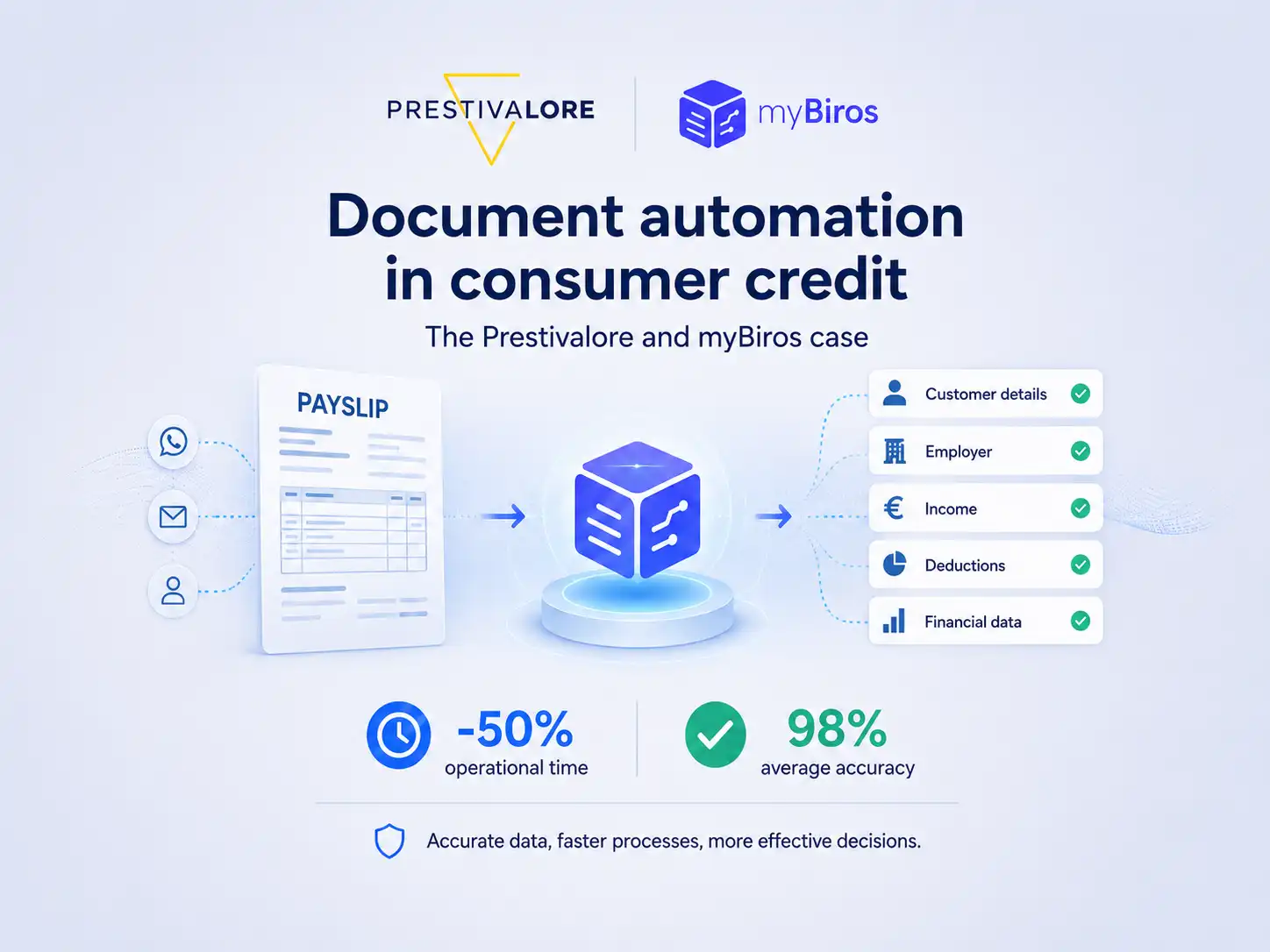
How Prestivalore reduced operational times by 50% with myBiros
Prestivalore processes approximately 90,000 documents each year, including payslips and identity documents. Thanks to myBiros, the company has automated data extraction, reduced manual work, and achieved an average accuracy rate of 98%.
Read it now
Beyond the Demo: The Hidden Complexities of Training and Validating VLMs for Document AI
Training a VLM for Document AI may look straightforward in a demo, but bringing it into production requires a robust pipeline: multimodal datasets, controlled fine-tuning, and reliable output validation.
Read it now


.svg)
.svg)
