


Information extraction: traditional vs modern solutions
The article reviews the process of extracting information from documents, traditionally done with rigid, inefficient methods. Modern solutions, however, offer greater flexibility and adaptability across different document types.

In document processing, the task of information extraction involves identifying and entering key data from documents into computer systems. This process can be applied to any type of document: structured, semi-structured, or unstructured.
For example, when processing an invoice, the relevant information to extract includes the issuing company, the issue date, and the address. From an identity document, the extraction focuses on personal data such as name, surname, and residence.
A generic pipeline for this task consists of three steps:
- Text recognition and transcription. Identifying the position of the text and converting it into machine-readable format.
- Information analysis. Identifying the key information of interest within the text.
- Post-processing (optional).Rrefining and validating the extracted results.

Information extraction from documents is a task that spans across all sectors. Due to the significant human intervention required, solutions capable of automating or semi-automating the process have become essential.
Traditional solutions
Traditional information extraction solutions from documents rely on rule-based and template-matching approaches. In template-matching, a mask is overlaid on the document image to filter the template and highlight the values to be extracted. In rule-based approaches, information is extracted using static rules applied after processing the document with an Optical Character Recognition (OCR) system. These methods work either independently or in combination, especially with structured and semi-structured documents, but require technical teams to configure the extraction systems. This configuration is static and demands technical intervention to handle each variation or new document type.

These solutions come with significant limitations and high development and maintenance costs. Additionally, they are unable to handle unstructured documents, as it is not feasible to establish predefined templates and rules for such documents.
Modern solutions
The use of machine learning methodologies has overcome many of the limitations of traditional solutions. This paradigm shift leads to fully data-driven approaches. The development and maintenance process for these solutions follows the structure outlined in the following diagram:

A generic approach involves training a system on a large dataset of documents to acquire a broad understanding of the application domain. The goal is to develop a system that can generalize to unseen documents, eliminating the need for constant reconfiguration to handle changes in formats or new document types.
This approach shifts the cost from continuous system configuration to the collection and creation of a high-quality dataset that accurately represents the various cases within the process of interest.
Such solutions can utilize techniques from fields like Computer Vision and Natural Language Processing (NLP). The latest advancements leverage neural networks, with the best-performing architectures being transformer-based models and graph neural networks.
You have the documents, we have the solution
myBiros is a next-generation solution for automating processes involving document processing. It leverages advanced deep learning techniques to overcome the limitations of traditional solutions. MyBiros is a no-code Document AI platform, offering ready-to-use cases and the ability to set up new cases quickly with just a few sample documents.
By using myBiros, companies can significantly reduce the costs associated with traditional document processing methods. The platform provides substantial savings in time, costs, and resources. Additionally, its features minimize the expenses related to acquiring data for model training.
With Human-in-the-Loop and Continuous Learning approaches, MyBiros continuously improves model performance through human feedback, achieving unparalleled accuracy and quality in data extraction.
The myBiros approach is entirely data-driven, making the pipeline fully adaptable to specific industry needs. By integrating techniques from Computer Vision and Natural Language Processing, myBiros interprets documents based on various characteristics, including text, layout, and the document’s visual elements.
Do you want to find out more about our solutions? Contact us!
Articles in the same category

Digital sale of RCA insurance policies: how IDP improves quotes and onboarding
IDP makes it possible to automatically extract data from RCA insurance policies and use it to generate personalized quotes, reducing manual form filling and abandonment in the digital funnel.
Read it now
Document AI: when general-purpose model APIs are not enough
General-purpose model APIs work well for prototypes, but at scale, document data extraction requires validations, integrations, and exception handling. The model is only one part of the system.
Read it now
AI for Gas and Electricity Switching: Less Friction, More Contracts
Extracting data from utility bills and documents still slows down many switching processes. With myBiros’ specialized AI, utilities and sales networks can automate data entry, reduce errors and accelerate contract signing.
Read it now
Accelerating Time-to-Yes in Lending with AI
AI accelerates the analysis of financial documents, reduces manual work, and transforms data into structured information, enabling banks and financial intermediaries to respond faster and improve their Time-to-Yes.
Read it now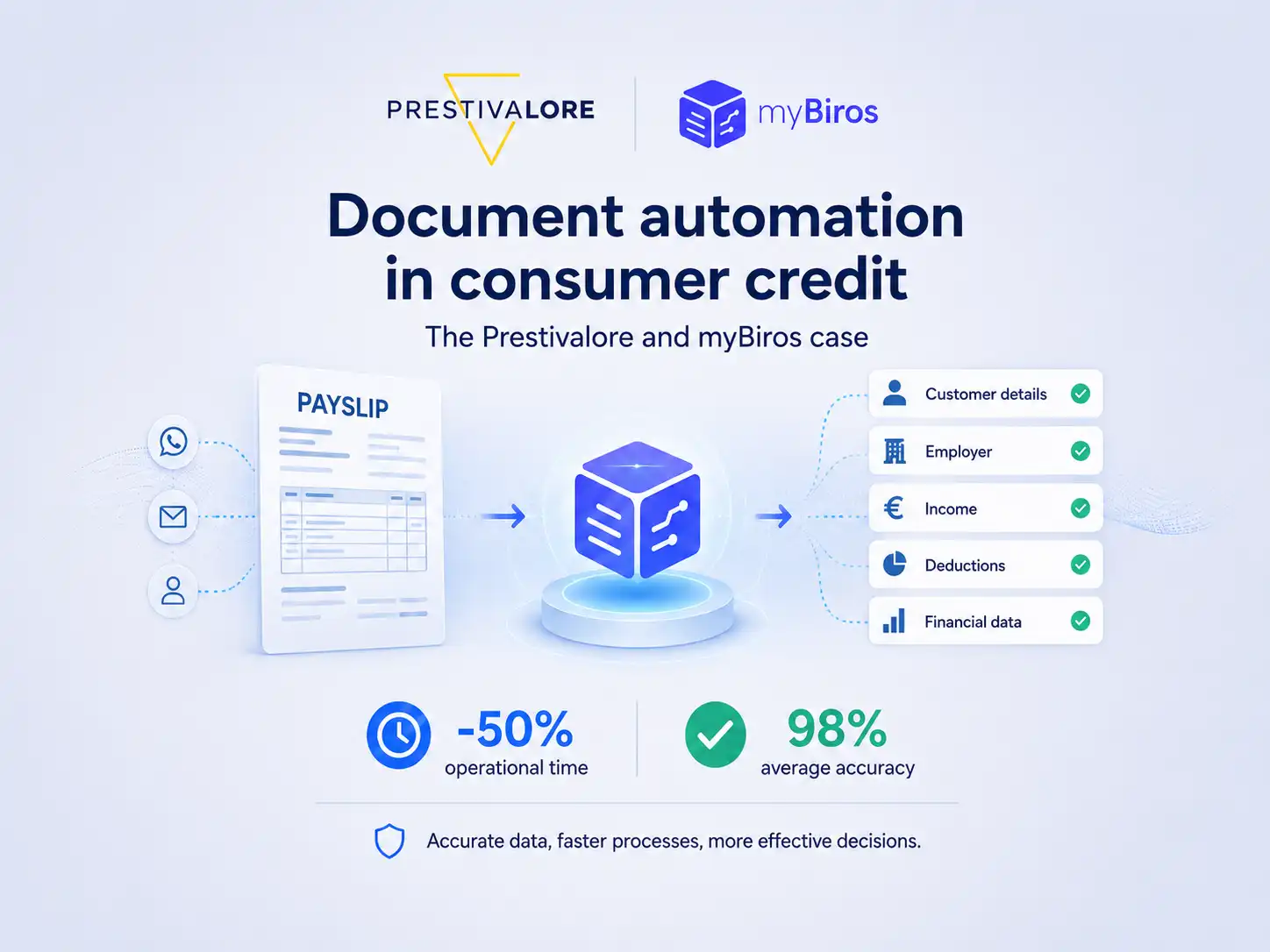
How Prestivalore reduced operational times by 50% with myBiros
Prestivalore processes approximately 90,000 documents each year, including payslips and identity documents. Thanks to myBiros, the company has automated data extraction, reduced manual work, and achieved an average accuracy rate of 98%.
Read it now
Beyond the Demo: The Hidden Complexities of Training and Validating VLMs for Document AI
Training a VLM for Document AI may look straightforward in a demo, but bringing it into production requires a robust pipeline: multimodal datasets, controlled fine-tuning, and reliable output validation.
Read it now


.svg)
.svg)
