


Why automate Expense Management processes?
Many companies still manage expenses manually, leading to reduced employee productivity. Today, expense management can be automated, significantly cutting down on time, costs, and the repetitive tasks that often lead to frustration.
Many companies still manage expenses manually, which significantly impacts employee productivity. Today, expense management can be automated, simplifying operations, reducing time, costs, and eliminating repetitive tasks that often lead to employee frustration. Companies of all sizes and industries can benefit from this transformation. In this article, we will explore why automating expense management is essential and identify who within the organization can gain the most from it.
Why automate expense management?
Nowadays, companies have automated many processes using technologies that enhance operational efficiency and optimization. However, there are several reasons why businesses often overlook automating expense management:
- Belief that they are not 'mature' enough to automate the expense management process.
- Perceived safety in using spreadsheets and paper-based expense reports.
While manual expense management can get the job done, it comes with significant challenges:
- High expenditure of time and costs.
- Increased risk of errors.
- Cumbersome, repetitive, and slow activities that drain productivity.
Automated expense management: who benefits?
Managing expenses manually is frustrating for everyone in the company. But who specifically benefits from automating expense management?
Employees
The first to benefit are employees, who want to minimize frustration in their work activities. They look for useful technological tools that can make their tasks smoother. By providing tools that eliminate the tedium and resulting frustration of drafting expense reports, as well as reducing errors, employees can become more productive and satisfied. This allows them to focus proactively on the jobs they were hired for, avoiding wasting valuable time.
Financial team
The financial team also greatly benefits from automating the expense reporting process. When managed manually, valuable data can be overlooked or hidden as untracked costs, such as:
- How much is being spent by the company.
- Who is spending it.
- Where and on what the money is being spent.
By automating the process, it becomes much easier to track all these aspects. Errors and fraud are minimized, invoices and reimbursements are processed on time, and financial decisions are based on precise and accurate data, providing a complete view of the company’s cash flow.
Business Executives
Executives also gain from process automation, as it helps them:
- Maximize profits while keeping costs under control.
- Reduce wasted time.
- Improve employee productivity, leading to happier, more satisfied teams.
Conclusion
Now that we've explored why automating expense management is crucial and the benefits it brings to the company and its teams, we invite you to contact us to learn more.
Interested in automating expense management for your company? Contact us for more information, we'd be happy to answer any questions you may have.
Articles in the same category

Digital sale of RCA insurance policies: how IDP improves quotes and onboarding
IDP makes it possible to automatically extract data from RCA insurance policies and use it to generate personalized quotes, reducing manual form filling and abandonment in the digital funnel.
Read it now
Document AI: when general-purpose model APIs are not enough
General-purpose model APIs work well for prototypes, but at scale, document data extraction requires validations, integrations, and exception handling. The model is only one part of the system.
Read it now
AI for Gas and Electricity Switching: Less Friction, More Contracts
Extracting data from utility bills and documents still slows down many switching processes. With myBiros’ specialized AI, utilities and sales networks can automate data entry, reduce errors and accelerate contract signing.
Read it now
Accelerating Time-to-Yes in Lending with AI
AI accelerates the analysis of financial documents, reduces manual work, and transforms data into structured information, enabling banks and financial intermediaries to respond faster and improve their Time-to-Yes.
Read it now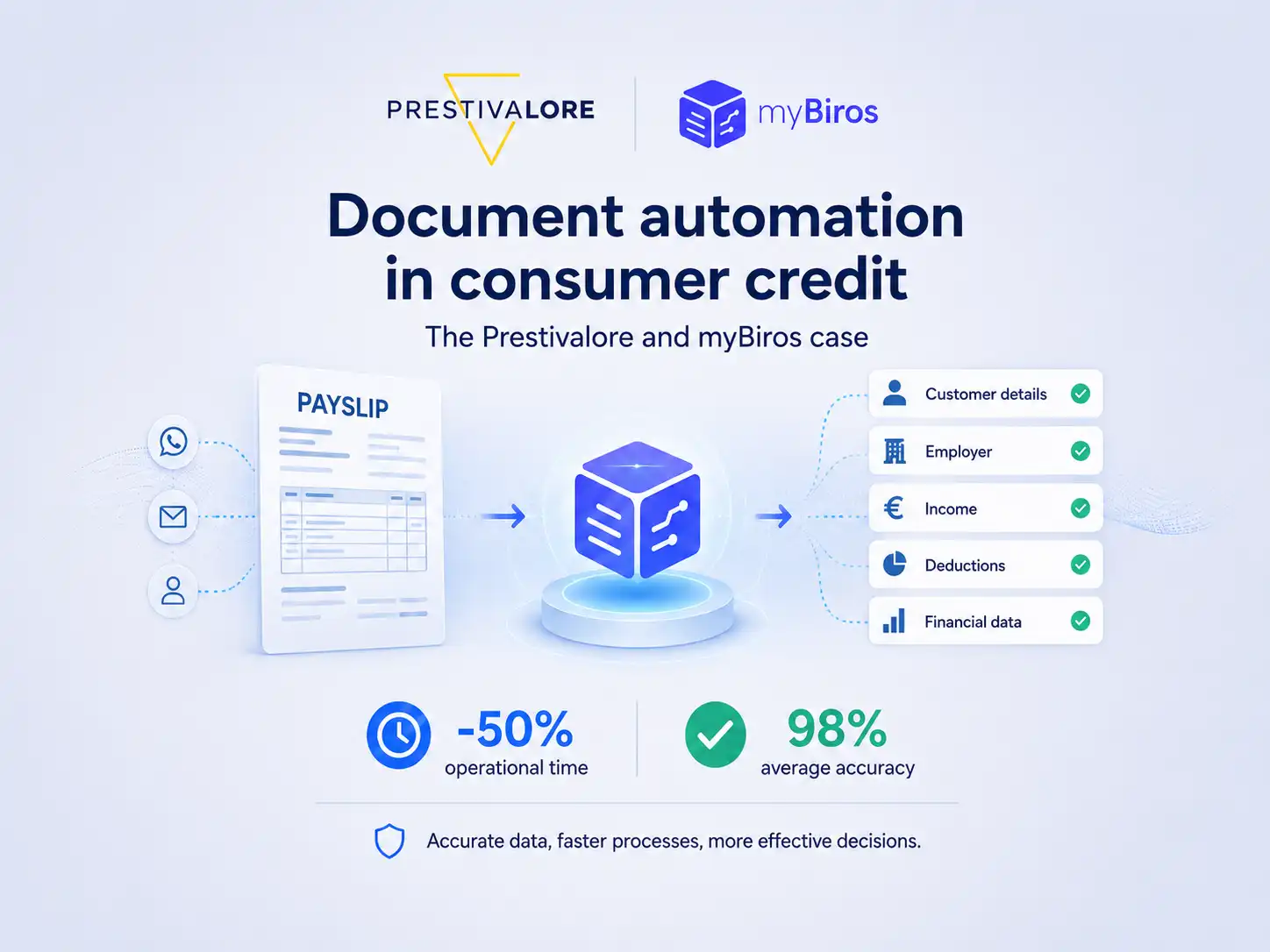
How Prestivalore reduced operational times by 50% with myBiros
Prestivalore processes approximately 90,000 documents each year, including payslips and identity documents. Thanks to myBiros, the company has automated data extraction, reduced manual work, and achieved an average accuracy rate of 98%.
Read it now
Beyond the Demo: The Hidden Complexities of Training and Validating VLMs for Document AI
Training a VLM for Document AI may look straightforward in a demo, but bringing it into production requires a robust pipeline: multimodal datasets, controlled fine-tuning, and reliable output validation.
Read it now


.svg)
.svg)
